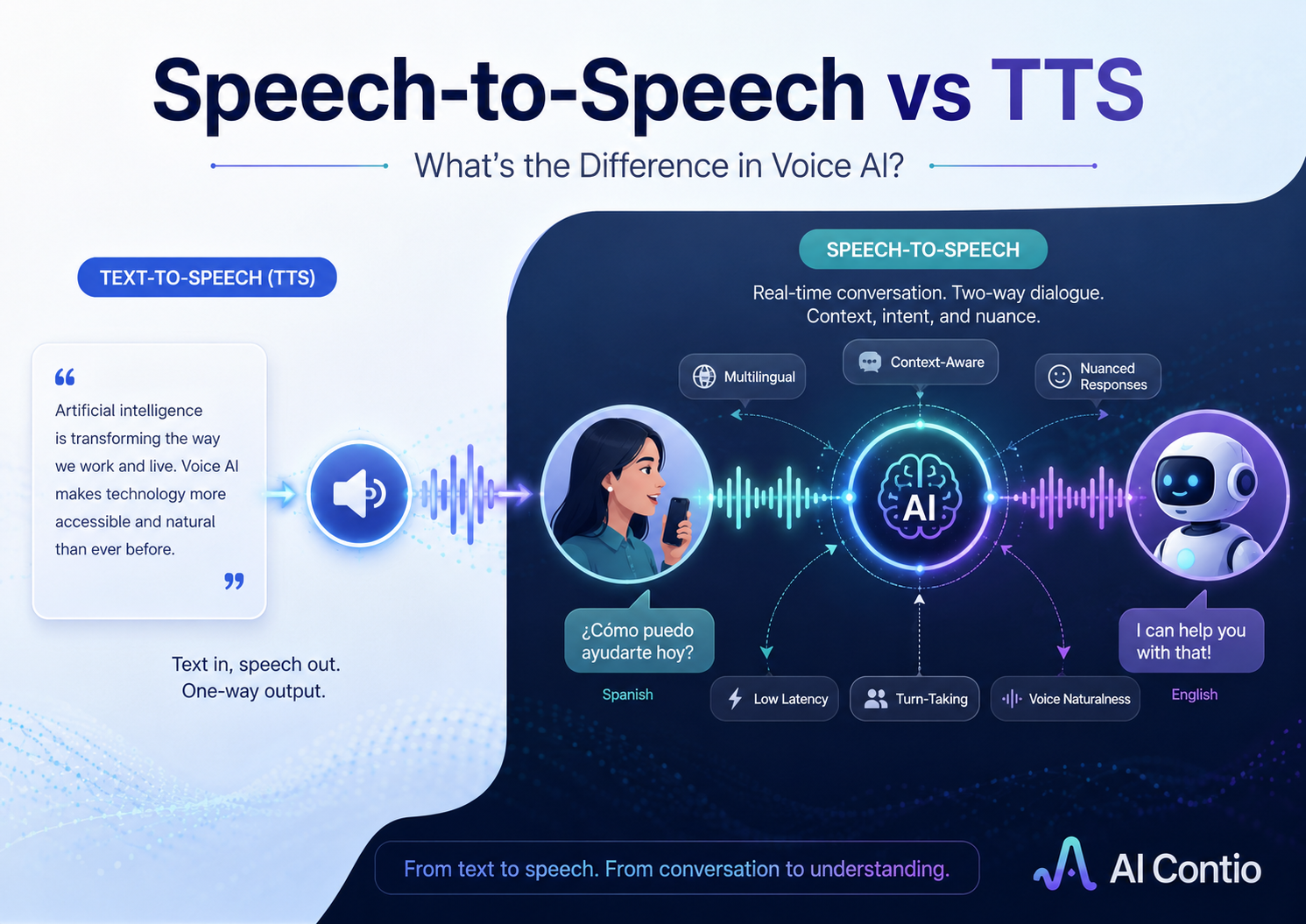
In Voice AI, one of the terms you are going to hear more often is speech-to-speech.
Like a lot of AI terms, it sounds obvious at first.
- The user speaks.
- The AI speaks back.
- Speech in. Speech out.
So isn’t every phone-based AI agent a speech-to-speech system?
Usually not.
The distinction matters because “speech-to-speech” is not just another way of saying “the bot has a voice.” It describes a different way of building a voice interaction. And that difference can affect latency, interruption handling, emotional tone, conversational naturalness, debugging, compliance, and production reliability.
At a simple level:
Text-to-speech, or TTS, turns written text into spoken audio.
Speech-to-speech turns spoken input into spoken output as part of a real-time conversational loop.
That sounds like a small difference.
In practice, it is a big architectural difference.
The Traditional Voice AI Pipeline
Most Voice AI systems have historically been built as a pipeline.
A caller speaks into the phone.
First, a speech-to-text engine listens and turns the caller’s audio into a text transcript.
Then a language model reads that transcript and decides what to say or do next. That text is basically the next prompt.
Just like when you type a prompt (question) into ChatGPT or Claude today, the LLM‘s output is text. You need to turn that text into speech (audio) so it can be heard on the phone call. So a text-to-speech engine takes the language model’s written response and turns it into audio.
The flow looks like this:
Caller speech → Speech-to-text → LLM → Text-to-speech → Caller hears audio
This is the classic, and currently most common, Voice AI stack.
It is modular. It is understandable. It is relatively easy to debug because each part of the system produces something you can inspect. You can look at the transcript. You can look at the LLM output. You can look at the text sent to the TTS system. You can listen to the final generated audio.
That visibility is useful, but it also creates seams.
Every component adds latency. Every handoff creates a failure point. The speech-to-text system may mishear the caller. The language model may respond to a bad transcript. The text-to-speech system may say the right words with the wrong tone. The caller may interrupt while the system is still generating or playing audio. For example, numbers are notoriously hard for a STT engine. Where we would say maybe “one fifty” or “one hundred fifty” for the number 150, a STT engine might say “one, five, zero” but even then it a less than natural cadence.
Because the future of Voice AI will not be won by the system that merely sounds the most human. It will be won by the system that handles the call the best.
This does not mean the pipeline approach is bad. In fact, it is still the most common production architecture for many real-time voice agents.
But it helps to understand that in this architecture, the TTS system is only the last stage.
The TTS does not understand the caller.
The TTS does not decide what to say.
The TTS does not manage the conversation.
The TTS does not know whether the caller is frustrated, confused, or trying to interrupt.
It speaks the text it is given.
That is its job.
What TTS Actually Does
Text-to-speech is a voice rendering layer.
You give it text, and it gives you audio.
Modern TTS can be extremely impressive. It can produce voices that sound natural, expressive, warm, professional, casual, energetic, calm, or brand-specific. Some systems allow voice cloning. Some allow control over pacing, tone, pronunciation, emotional delivery, language, and accent. Currently ElevenLabs is the industry leader in TTS rendering.
That is powerful.
But it is important not to confuse voice quality with conversational intelligence.
A TTS system can make a bad answer sound beautiful.
It can make a broken workflow sound polished.
It can make a hallucinated answer sound confident.
It can make a failed escalation sound friendly.
This is one of the traps in Voice AI demos. People hear a great synthetic voice and assume the system underneath is sophisticated. Sometimes it is. Sometimes it is just a good voice sitting on top of a fragile workflow.
TTS is important, but TTS is not the agent.
It is the mouth.
What Speech-to-Speech Means
A speech-to-speech Voice AI solution is designed around real-time audio conversation.
Instead of treating voice as something that gets bolted onto a text-based interaction, the system treats spoken conversation as the primary interface.
In some systems, speech-to-speech may still include internal transcription and text reasoning behind the scenes. In others, the model may process audio more directly and generate audio more directly. The implementation can vary.
But conceptually, the important shift is this:
- The system is not merely generating spoken audio from completed text.
- It is managing a live spoken interaction.
- That means it needs to deal with the realities of human conversation:
Interruptions.
Partial thoughts.
False starts.
Pauses.
Background noise.
Overlapping speech.
Tone.
Urgency.
Caller hesitation.
Timing.
Turn-taking.
Repair.
Clarification.
A good speech-to-speech system is not just trying to sound better. It is trying to converse better.
That is a very different goal.
A Simple Analogy
Think of the difference between reading a script aloud and having a conversation.
TTS is like giving a talented voice actor a script and asking them to read it.
The voice actor may do an excellent job. The pacing may be great. The tone may be natural. The delivery may be emotionally appropriate, but the voice actor is still reading what was written.
Speech-to-speech is closer to putting someone in a live conversation.
They are not just reading. They are listening, timing their response, deciding whether to continue, deciding whether to pause, noticing when the other person interrupts, and adapting in real time.
That does not automatically make speech-to-speech better for every use case, but it does make it different.
Why This Matters in Voice AI
The difference matters most when the caller experience is interactive.
If you are generating an audiobook, voicemail greeting, training narration, product video, or podcast intro, TTS may be exactly what you need. You have text. You want audio. The interaction is not live, but if you are building a phone agent that answers real customer calls, the problem is different.
- The caller may not say what you expect.
- They may ask two questions at once.
- They may interrupt.
- They may get impatient.
- They may answer the wrong question.
- They may give information out of order.
- They may say, “Actually, never mind,” halfway through a sentence.
- They may ask, “Are you a real person?”
- They may be calling from a car, a job site, a kitchen, a warehouse, or a windy parking lot.
That is where the limitations of a simple text-in/audio-out approach become visible.
In real calls, the quality of the experience is often determined less by the prettiness of the voice and more by the system’s ability to manage the timing and structure of the conversation.
- Can it respond quickly?
- Can it stop talking when interrupted?
- Can it recover when it misunderstood something?
- Can it ask a short clarifying question instead of giving a long explanation?
- Can it avoid talking over the caller?
- Can it handle silence?
- Can it escalate when the conversation is going badly?
- Can it preserve context across turns?
These are speech interaction problems, not just speech generation problems.
The Latency Issue
Latency is one of the biggest reasons people care about speech-to-speech.
In a traditional pipeline, every stage takes time.
The system has to detect that the caller has stopped speaking.
Then it has to transcribe the audio.
Then it has to send the transcript to the language model.
Then it has to generate a response.
Then it has to send the response to the TTS system.
Then it has to stream audio back to the caller.
Each step may be fast on its own, but the total can still feel slow.
And in voice, “a little slow” feels much worse than it does in text.
In chat, a two-second delay may be fine.
On the phone, a two-second delay can feel awkward. A three-second delay can make the caller say, “Hello?” A four-second delay can make the caller think the call dropped.
Speech-to-speech systems are often designed to reduce that awkwardness by operating more continuously. They may begin processing while the caller is still speaking. They may stream responses. They may handle turn-taking more naturally. They can reduce the feeling that the caller is talking to a sequence of disconnected components.
But this is where the marketing can get slippery.
“Speech-to-speech” does not automatically mean “low latency.”
A poorly implemented speech-to-speech system can still feel slow and a well-implemented pipeline can feel very fast.
The architecture matters, but the execution matters more.
The Barge-In Problem
Another major difference is interruption handling, often called barge-in.
Humans interrupt each other constantly. Not always rudely. Often practically.
If I call a service business and the AI starts giving me a long explanation, I may interrupt with, “No, I already have an appointment.”
A good voice agent should stop, listen, and adjust.
This is harder than it sounds.
In a basic TTS-driven pipeline, the system may already be playing generated audio. The caller starts talking over it. The system has to detect the caller’s speech, stop playback, capture the new input, decide whether the interruption was meaningful, and update the conversation.
That is not a TTS problem.
That is a real-time audio orchestration problem.
Speech-to-speech systems tend to put more emphasis on this kind of interaction because interruptions are native to spoken conversation. Again, this does not mean every speech-to-speech system handles barge-in well, but it does mean barge-in is part of the core problem space.
The Emotional Tone Issue
TTS can add emotion to speech.
But there is a subtle difference between expressing emotion and responding to emotion.
A TTS system can say, “I’m sorry to hear that,” in a sympathetic voice.
A speech-to-speech system may be better positioned to notice that the caller sounds upset, rushed, confused, uncertain, or angry, and adapt the interaction accordingly.
That distinction matters.
In business calls, the words are only part of the signal. Tone, pacing, hesitation, and urgency can matter too.
Anyone who has ever been in a relationship knows that “fine” can have multiple and vastly varried meanings. A caller saying “fine” may mean “fine,” or it may mean “I am done with this conversation.”
A caller pausing for five seconds may be thinking, or they may be looking for information, or confusted or they may have simply walked away or been called away.
Text transcripts flatten a lot of that context. Sometimes that is acceptable. Sometimes it is not.
Speech-to-speech systems are partly interesting because they may preserve more of the original audio signal in the interaction.
But this also introduces new questions.
- How much should the system infer from tone?
- How reliable are those inferences?
- How should it behave when the audio signal is noisy?
- How do you test whether it is helping or just guessing?
As usual, the demo is the easy part. Production is harder.
Speech-to-Speech Is Not Magic
This is the point I would emphasize most.
Speech-to-speech is not magic.
It does not eliminate the need for good conversation design, or integration or error handling. It does not eliminate the need for escalation paths or observability. It does not eliminate the need to test real callers in real conditions.
In fact, in some ways it increases the need for observability because the system can become more opaque.
In a traditional pipeline, you can inspect the transcript, the prompt, the model response, the TTS input, and the audio output.
In a more native speech-to-speech system, the boundaries may be less obvious.
That may improve the experience, but it can make debugging more difficult.
When something goes wrong, you still need to know why.
- Did the system mishear the caller?
- Did it misunderstand the intent?
- Did it choose the wrong tool?
- Did it respond with the wrong tone?
- Did it fail to stop when interrupted?
- Did the caller pause too long?
- Did background noise trigger the wrong behavior?
- Did the model have the right context?
A more natural conversation is good, but a more natural black box is dangerous.
When TTS Is the Right Tool
There are many cases where TTS is exactly the right solution.
If the task is mostly one-way audio generation, TTS is the obvious choice.
Examples include:
- Narration.
- Training content.
- Marketing videos.
- IVR prompts.
- Voicemail greetings.
- Product explainers.
- Accessibility features.
- Audio versions of written content.
- Scripted outbound messages.
In these cases, you may not need a speech-to-speech system. You need high-quality audio rendering.
The user is not having a live conversation with the system. Instead, they are passively listening. For that job, a great TTS engine may be more than enough.
When Speech-to-Speech Matters
Speech-to-speech matters when the interaction is live, dynamic, and conversational.
Examples include:
Inbound customer service agents.
Appointment booking agents.
Sales qualification agents.
Technical support triage.
After-hours answering services.
Healthcare intake workflows.
Field service dispatch.
Receptionist-style agents.
Real-time coaching or tutoring.
In these cases, the system has to do more than speak.
It has to listen well, respond quickly, manage turns, recover from mistakes, and keep the caller moving toward an outcome.
This is where speech-to-speech becomes strategically important.
Not because it sounds more human.
Because it may reduce friction in the live interaction.
Is Speech-to-Speech Better for Translation and Multiple Languages?
Speech-to-speech can be especially useful in multilingual voice interactions, but it is worth being precise about why.
The advantage is not simply that speech-to-speech “knows more languages.” A traditional voice pipeline can also support many languages by combining speech-to-text, translation, language-model reasoning, and text-to-speech.
The difference is the interaction experience.
In a traditional pipeline, the caller’s speech is usually converted into text first. Once that happens, some of the original spoken signal may be flattened. Accent, hesitation, pacing, emotion, emphasis, and conversational timing may not fully survive the trip through transcription.
For some use cases, that is perfectly fine.
For live translation or multilingual customer conversations, however, those details can matter. A speech-to-speech system may be better positioned to preserve the flow of the conversation, respond with less delay, handle language switching more naturally, and produce spoken output that feels less like a translated script and more like a real exchange.
That does not mean speech-to-speech is automatically more accurate.
A well-built speech-to-text plus translation plus TTS pipeline may outperform a speech-to-speech system in certain languages, domains, accents, or compliance-sensitive workflows. It may also be easier to inspect and debug because the intermediate transcript and translated text are visible.
So the practical buyer question is not, “Does this support multiple languages?”
The better questions are:
Can it handle callers switching languages mid-conversation?
Can I inspect what was heard and translated?
Does it preserve names, addresses, numbers, and industry-specific terms?
How much latency does translation add?
Can the agent keep the same context across languages?
Does the voice sound natural in each supported language, or only in English?
For multilingual Voice AI, speech-to-speech is promising because it may improve the live conversational experience. But accuracy, observability, and language coverage still have to be tested.
The Buyer’s Question
If you are evaluating a Voice AI vendor, I would not simply ask, “Do you support speech-to-speech?”
That question is too easy to answer with a yes.
I would ask more specific questions:
- What happens when the caller interrupts the agent?
- Can I see the transcript and audio timing side by side?
- Where is the boundary between speech recognition, reasoning, and speech generation?
- How do you measure latency?
- Do you measure time-to-first-audio or only total response time?
- Can the system start processing before the caller fully finishes speaking?
- How does it handle background noise?
- How does it decide when a caller has finished a turn?
- Can I inspect what the model heard, what it decided, and what it said?
- Can I test the same call using different prompts or agent versions?
- What happens when the system is uncertain?
- Can it transfer to a human quickly?
Those questions matter more than the label.
The Practical Definition
Here is the simplest definition I would use:
A text-to-speech system converts text into spoken audio.
A speech-to-speech Voice AI system manages a real-time spoken conversation, taking speech as input and producing speech as output, while handling the timing, interruptions, turn-taking, and context that make live conversation work.
That is the distinction.
TTS is a component.
Speech-to-speech is an interaction model.
And for Voice AI, that distinction matters.
Because the future of Voice AI will not be won by the system that merely sounds the most human. It will be won by the system that handles the call the best.
#AI #AI Voice #LLM #speech to speech #Speech-to-speech #STT #TTS #Voice AI