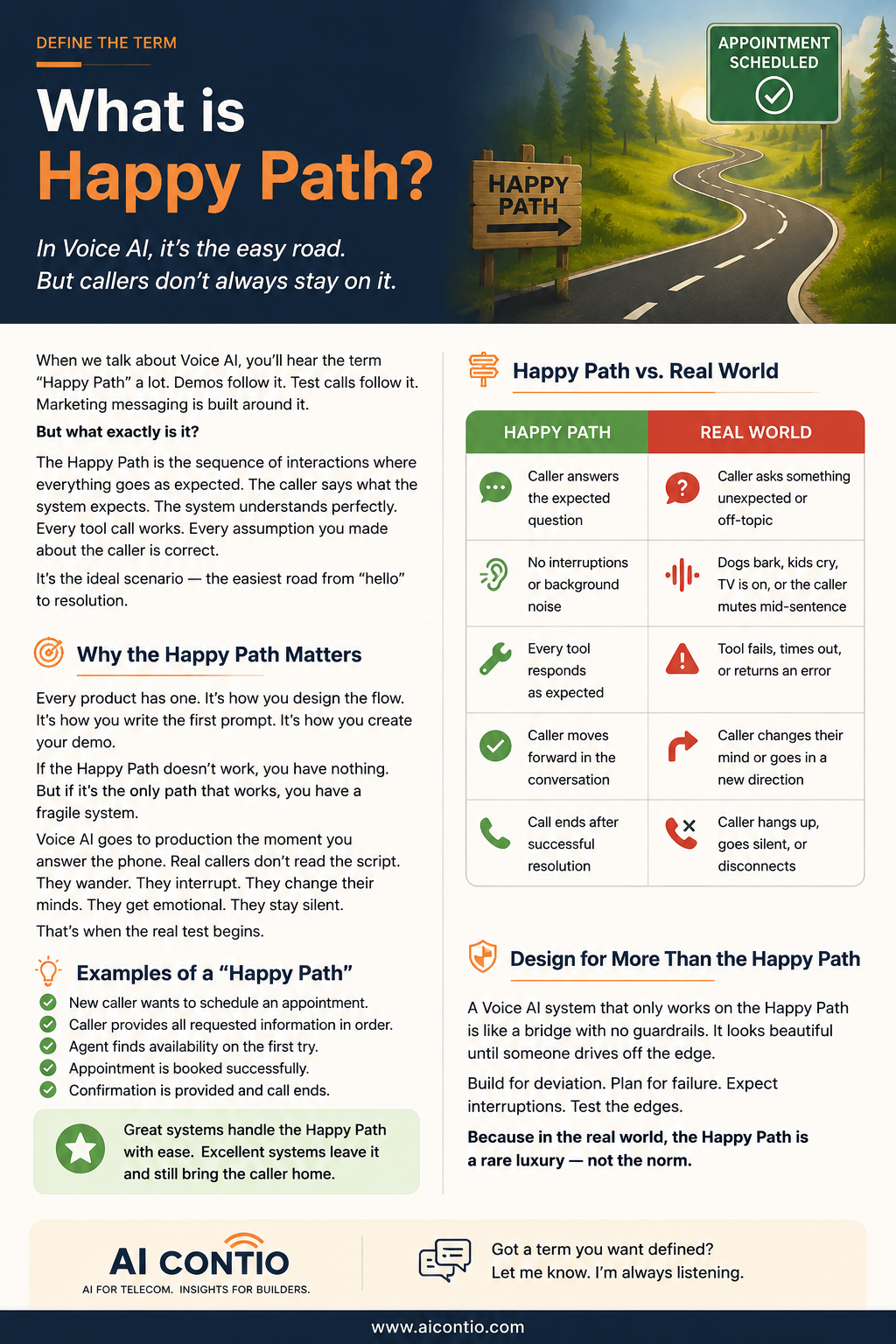
The definition
The happy path is a term borrowed from software testing. It describes the default scenario: the user does exactly what the system expects, in exactly the order the system expects, with no typos, no second-guessing, no interruptions, and no edge cases. Every field gets filled correctly the first time. Every question gets a clean answer. Nothing goes wrong because nothing unusual happens.
In voice AI, the happy path looks like this: the caller says clearly what they want, answers each question in turn, doesn’t talk over the agent, doesn’t change their mind, and hangs up satisfied. Greeting, intent, booking, confirm. Four steps, no detours.
It is also, almost without exception, the only path most voice AI products are built and demoed against.
Why the happy path is where demos live
A demo has one job: look good in five minutes to someone who hasn’t decided to buy yet. The fastest way to do that is to script the interaction, even implicitly, so that every call looks like the happy path. Sales demos are conducted by people who know the right things to say. Self-serve trial widgets get tested by builders who, consciously or not, talk to their own agent the way they built it to be talked to.
None of this is dishonest. It’s just selection bias with a microphone. The happy path is real, and plenty of production calls do run through it cleanly. But it is the easiest 80 percent of the problem, and it is the 80 percent every vendor has already solved, because it is the only 80 percent anyone tests before shipping.
The other 20 percent is where the actual craft lives, and it’s the part a five-minute demo will never show you.
What lives off the happy path
Across the Behind the Call series, the same handful of off-path scenarios keep surfacing as the place agents actually break:
The caller interrupts. Barge-in sounds like a small feature until an agent handles it badly, and then it’s the whole call. An agent that can’t recover cleanly from being cut off mid-sentence reads as broken in a way that has nothing to do with its actual intelligence.
The caller contradicts themselves. They give one address, then a different one. They say Tuesday, then mean Wednesday. A happy-path agent takes the first answer and moves on. A production-grade agent notices the contradiction and reconciles it before committing to a calendar entry a human will have to unwind later.
The request goes off-script. A caller asks something the agent’s prompt never anticipated, sometimes an out-of-scope medical or legal question, sometimes just a meta-question about whether they’re talking to a robot. What happens next tells you whether the thing has a scope boundary or just a fixed sequence of questions with no edges.
The booking is more complex than one field. A caller wants three property showings, not one. A caller needs a plumber for a specific fixture, not a generic leak. The happy path collects a time slot. The off-path version needs the agent to ask what a human receptionist would ask, because otherwise the booking that lands on the calendar is missing the operational detail whoever picks up the job actually needs.
Something the agent promised doesn’t happen. The agent says “I’ll transfer you now” or “you’ll get a confirmation text,” and the backend either never executes it or executes it silently wrong. This is its own failure mode, distinct from the others, because the agent sounds confident the entire time. It’s worth its own definition another Wednesday.
None of these are exotic. They’re ordinary. A human receptionist handles all five without thinking about it. The happy path is not a low bar because it’s easy for a machine and hard for a person, it’s a low bar because it’s the only bar most products have actually been tested against.
Why this is the actual thesis of the teardown series
Every Behind the Call piece runs the same test: call the thing more than once, more than a handful of times, and specifically try to walk off the happy path on purpose. Not to be adversarial for its own sake, but because that’s the only way to find out what an operator is actually buying. A platform that handles the happy path well and nothing else will produce a beautiful demo and a string of frustrated callers within the first week of going live.
This is also the cleanest way to explain the difference between a craft-layer gap and a platform-layer gap. A craft-layer gap is something the operator can fix with a better prompt: ask for the specific property, reconcile the contradiction, hold a wider scope boundary. A platform-layer gap is something no amount of prompt engineering fixes, because the underlying system doesn’t expose the hooks needed to catch the problem at all. You can only tell the two apart once you’ve left the happy path, because on the happy path they look identical: both work fine.
How to test for it
You don’t need six calls and a receipt ledger to start finding this in your own deployment. Three cheap tests surface most of it:
Say something, then contradict yourself two sentences later, and see if the agent notices.
Interrupt the agent mid-sentence and see how it recovers, not whether it recovers at all, but whether the recovery feels like a conversation or a reset.
Ask for something slightly more complicated than the simplest version of the thing the agent is built for, and see whether it asks the follow-up question a competent human would ask before committing to an answer.
If all three come back clean, you’re looking at something built past the happy path. If any of them come back with a confident, wrong answer, you’ve found the gap between what the demo showed you and what your callers are going to get.
The Best Voice AI Feels Boring
Ironically, the best production Voice AI often looks less impressive in a demo. That’s because an enormous amount of engineering has gone into handling the situations that hopefully never happen.
- Recovery logic.
- Retries.
- Fallbacks.
- State management.
- Confirmation prompts.
- Graceful handoffs.
These aren’t flashy features.
They’re what make the system reliable.
Final Thought
Every Voice AI product needs a Happy Path. It’s how you design your conversation, but if that’s the only path you’ve designed, your customers will quickly find all the others.
The difference between a demo and production isn’t the AI model.
It’s everything that happens once the caller leaves the Happy Path.
#AI Voice #ai voice testing #happy path #Voice AI