A fellow voice AI founder recentely asked me why I shut down Euphonia. I gave him the short answer: we didn’t get the traction we wanted, and we were a little early.
That answer is true but not very useful. Every founder whose company folded says they were early. Here’s what “early” actually meant for us.
The market that needed us most couldn’t hear us
We started with home services: roofers, HVAC, electricians, plumbers. On paper it was the perfect market. These businesses badly need voice AI because they don’t answer their phones. The owner is on a ladder or in a crawlspace, and the call goes to voicemail.
That’s also the problem. If a business never answers its phone, you can’t call it to sell it something. Outbound sales into a market defined by unanswered calls is hard.
When we did get a receptionist on the line, the pitch was basically: “Interested in a product that does your job?” That conversation goes about how you’d expect.
“A roofer is a roofer” (except to the roofer)
To the average homeowner, a roofer is a roofer, with no disrespect to roofers. If I’m looking for a roofer, I google roofers near me and start calling the list. The same goes for HVAC and electricians. If one doesn’t pick up, I call the next one on the list.
Steve Jones of Jones Roofing doesn’t see it that way, and he isn’t wrong to be proud of his work. In his mind, people call Jones Roofing to reach him, so they’ll call back. A missed call isn’t a missed opportunity. It’s a call he’ll get to later.
That belief is the core of the buyer readiness problem. You can’t sell a fix to someone who doesn’t think anything is broken.
Zero cost vs. a line item
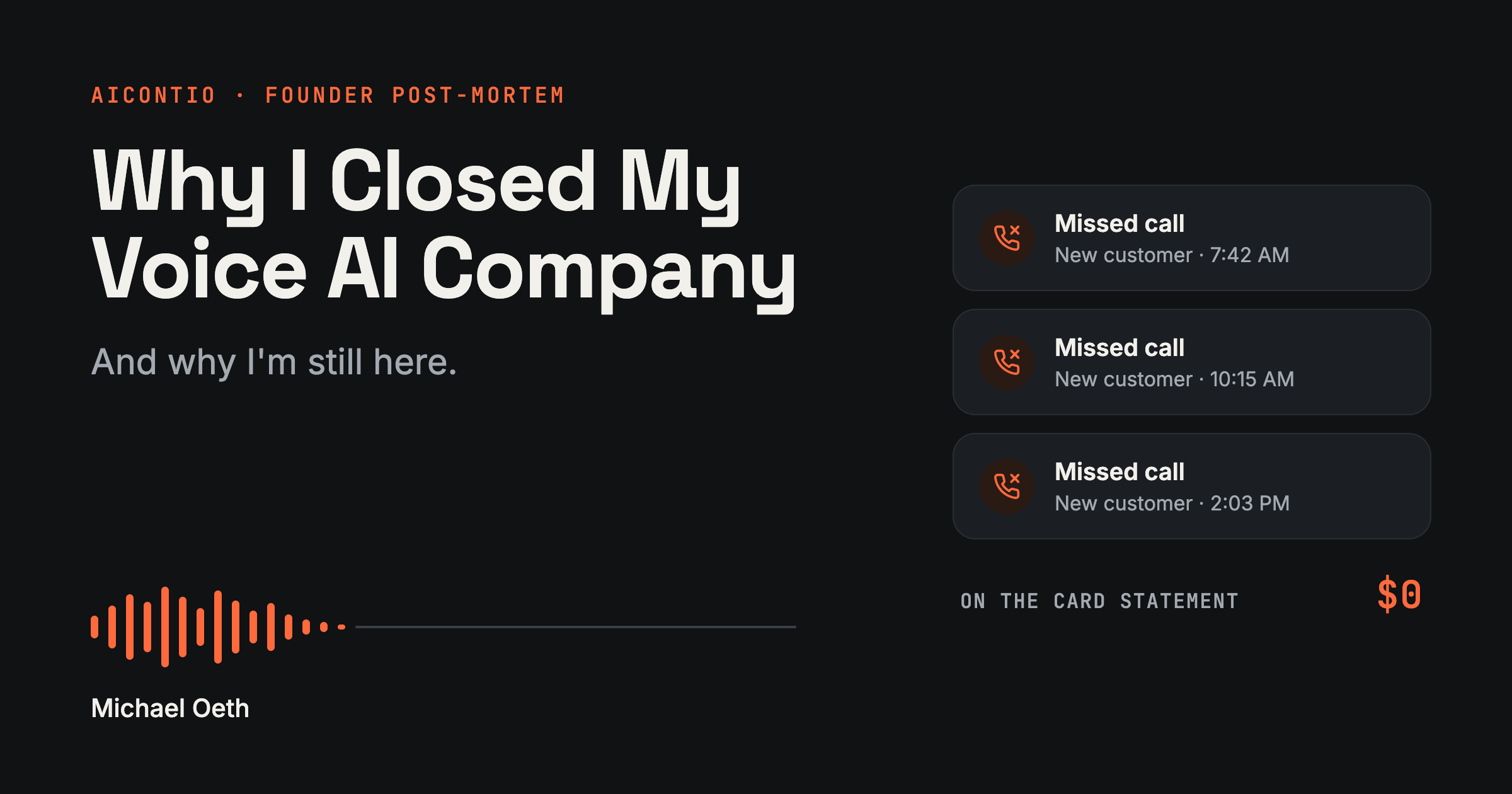
The last piece is simple accounting. A missed call doesn’t show up on a credit card statement. A voice AI subscription does.
So the comparison the owner makes isn’t “lost revenue vs. cost of the solution.” It’s “$0 vs. $X a month.” Opportunity cost is real, but it’s invisible, and an invisible cost loses to a visible one almost every time.
What I got wrong as a telecom founder
I spent 15 years building and running OnSIP, a hosted PBX and SIP company. I came into voice AI with a telecom mental model, and part of it was wrong.
In VoIP, you set it up and you’re largely done. You handle moves, adds and changes, and that’s about it. Once a customer is provisioned, it just works.
Voice AI is nothing like that. Deploying an AI agent is closer to hiring and training an employee. You have to monitor calls and review logs. You handle edge cases you didn’t anticipate. You keep information current and, just as important, remove information that’s out of date. There’s no set it and forget it.
That changes the economics, the support model and the sales pitch. If you sell voice AI like a phone system, the customer expects a phone system’s maintenance burden, and they’re surprised when it’s more than that.
Why I stayed
We got into this space because AI and voice are a natural fit. It makes sense for AI to handle some or all of a company’s calls, and the models had finally gotten good enough to do it.
That’s still why I’m here. What has changed in the last year or so is the tooling around the models. The pieces needed to make voice AI viable as a business, not just as a demo, now exist.
I took what I learned at Euphonia into my consulting practice. Most of it comes down to three questions I now ask about any voice AI go-to-market plan:
- Can you reach your buyer? If your market’s defining problem is that they’re unreachable, your channel strategy has to account for it.
- Does your buyer agree they have the problem? Not whether they have it, but whether they believe they do.
- Who maintains the agent after launch? If the answer is “nobody,” it will fail.
We were early. But “early” was really a buyer that couldn’t hear the pitch, didn’t think it had a problem, and was comparing us to zero.
#AI #AI Voice #AI Voice Agent #entrepreneurship #LLM #Voice AI