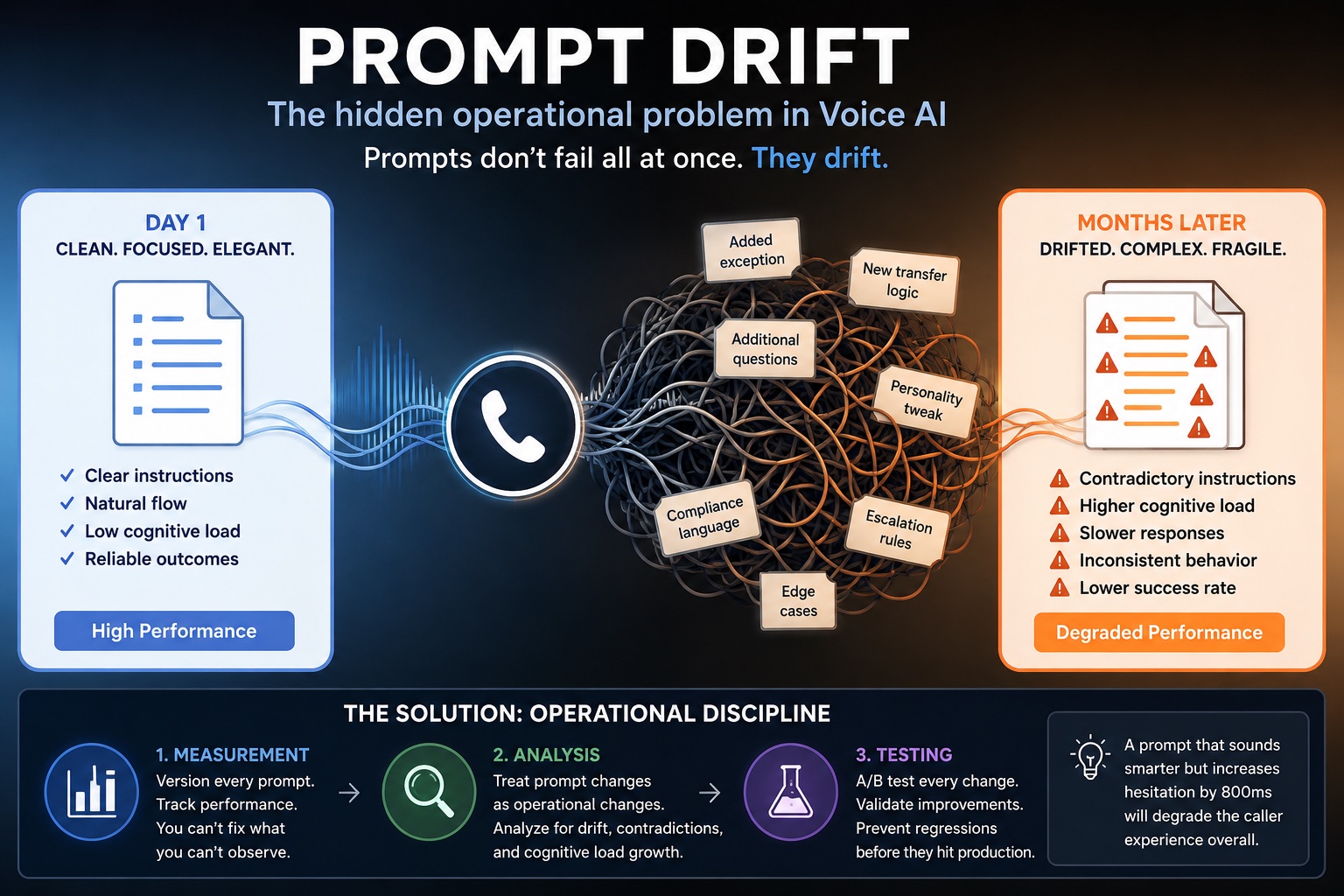
Prompt drift is one of the most important operational problems emerging in Voice AI today, yet very few teams are talking about it directly.
History
Most software engineers are familiar with the term “spaghetti code.” It describes software that slowly becomes difficult to manage as features, exceptions, workarounds, and patches accumulate over time. At first, the codebase is elegant. Clean architecture. Clear intent. Understandable logic.
But then reality happens.
New features are added. Edge cases emerge. Customers request exceptions. Integrations evolve. Operating systems change. Developers patch issues quickly to keep momentum moving.
Months or years later, the original elegance disappears beneath layers of intertwined logic that nobody fully understands anymore.
Prompt Drift
The exact same thing is beginning to happen with AI prompts, particularly in Voice AI systems. Like software code, prompts are effectively executed every time a phone call is answered.
A prompt may begin as a beautifully structured conversational framework. The first version often performs surprisingly well. But as the system encounters real-world callers, complexity starts accumulating rapidly.
An interruption gets mishandled, so another instruction is added.
A transfer fails, so more transfer logic is inserted.
A customer wants additional qualification questions, so another conversational branch appears.
Someone notices the AI sounding too robotic, so personality instructions are expanded.
Compliance language gets inserted. Escalation rules are patched in. Tool usage instructions grow longer. Edge cases pile up.
Eventually the prompt stops behaving like a conversational framework and starts behaving like a giant pile of layered operational exceptions.
This is prompt drift.
Over time, prompts often become increasingly contradictory, fragmented, and cognitively expensive for the model to process. Instructions begin competing with one another. Important behaviors get buried inside unrelated sections. New logic conflicts with earlier assumptions.
The result is not always immediate failure.
In fact, prompt drift is dangerous precisely because the degradation is usually gradual.
Response latency slowly increases.
Agent cognitive load and hesitation become more common.
Transfer reliability declines.
Conversation flow becomes less natural.
Different customer deployments begin behaving inconsistently.
Six months later, nobody fully understands why the system behaves the way it does anymore.
At that point, the problem starts looking less like prompting and more like operational entropy.
What makes this even more interesting is that AI-generated prompts are not immune to the problem. In some organizations, prompts are now being generated, modified, or patched by other AI systems. That introduces a second layer of drift. The prompt-generation framework itself can slowly accumulate conflicting goals, outdated assumptions, and fragmented operational logic. Over time, organizations may find themselves debugging not just production prompts, but the systems used to create them.
Even well-designed prompts created by disciplined teams can experience prompt drift over time.
The Solution
The solution is not simply “better prompting.”
The solution is operational discipline.
Measurement
The first step is measurement.
You cannot fix what you cannot observe.
Every production Voice AI deployment should be tracking prompt versions alongside operational metrics such as response latency, transfer success, customer sentiment, escalation frequency, interruption handling, and conversation outcomes. Calls should be traceable back to the exact prompt version responsible for the behavior.
Without version-level observability, teams are effectively debugging conversational systems by intuition alone.
Analysis
The second step is analysis.
Every meaningful prompt modification should be treated as an operational change, not just a text edit. Whether a human or an AI generates the updated prompt, the new version should be independently analyzed for contradictions, cognitive load growth, hidden complexity, and structural drift.
Emerging tooling platforms such as Prompt-Whisperer are beginning to focus specifically on prompt analysis, structural evaluation, and operational drift detection for Voice AI systems.
Testing
The third step is testing.
Prompt changes should not immediately replace existing production systems without validation. New prompt versions should be A/B tested against prior versions to evaluate both conversational performance and operational impact. Improvements in one area can easily create regressions elsewhere.
Conclusion
A prompt that sounds smarter but increases hesitation by 800 milliseconds will degrade the caller experience overall.
As Voice AI deployments scale, prompt management will increasingly resemble software lifecycle management rather than traditional copywriting.
Prompt drift may ultimately become less of a prompting problem and more of a software operations discipline problem.
#AI #ai drift #prompt drift #spaghetti code #spaghetti prompt #Voice AI