
RealVoice AI: Who It’s For, Who Should Skip
If you’ve been on a SaaS landing page in the last six months, you’ve seen the pitch: AI receptionist, 60-second setup, never miss a lead. RealVoice AI sits squarely in that lane, with one clear positioning hook: “Like LiveChat, but visitors talk instead of type.” It’s a website voice widget that answers questions, books appointments, and captures leads, starting at $99/month.
I spent some time poking at the product surface and the marketing claims. Here’s the honest buyer’s guide.
TL;DR. RealVoice is optimized for speed-to-deployment, not deep conversational design.
What you’re actually buying
The headline product is a voice widget you embed with one script tag. Visitors click, talk, and an AI agent trained on your scraped website content handles the conversation. The same agent also picks up phone calls (they provision a local or toll-free number) and works through QR codes on menus or flyers. One AI, three channels, $99/mo with no setup fee.
The build flow is genuinely simple on paper:
- They scan your site to train the agent
- You pick a voice (12+ options) and brand colors
- You drop in a script tag
- Leads route to email and Google Sheets
There’s also a “coming soon” AI-to-human handoff feature, and an upsell ladder into AI SDRs, sales closers, and reactivation agents — which tells you where the company actually wants to take customers over time.
The Setup
The setup for the demo was exactly as stated – give us your URL and we’ll setup a demo in sixty seconds. I put in my URL and a minute later I had a mockup of the website with a widget in the lower right corner. Clicking on that widget brought the AI to life.
First Call
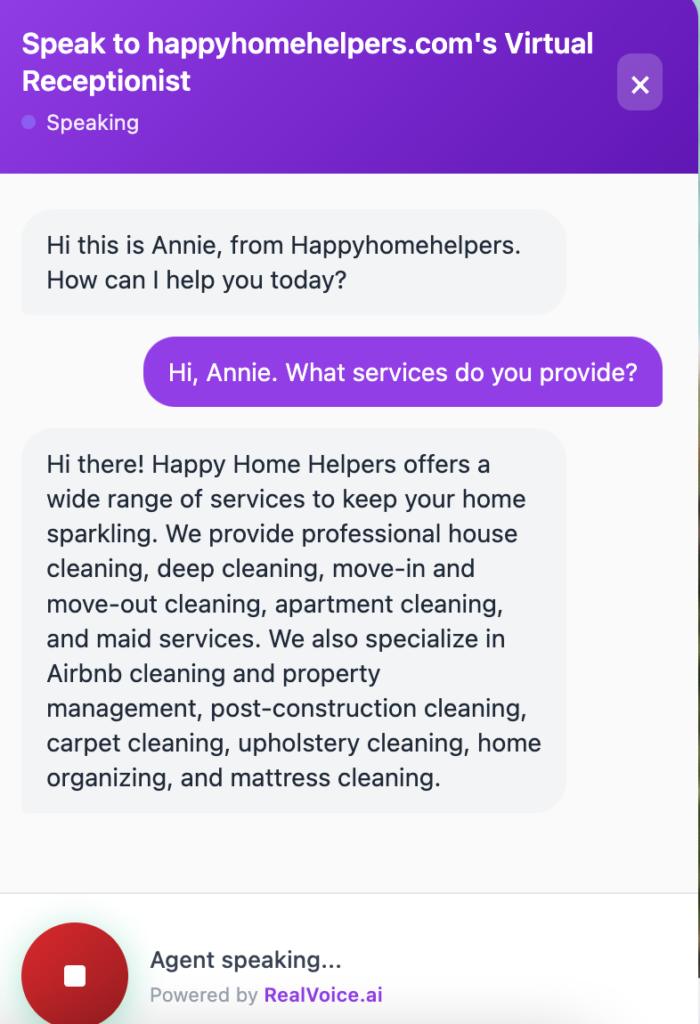
Oh no! The dreaded “How can I help you?” opening response. The responses also skew long-winded. It sometimes feels more like listening to a lecture than participating in a conversation. For voice interactions, the agent would benefit from and I would recommend shorter, more conversational responses.”
The rest of the conversation went really well with the AI answering thoughtfully. I tested some edge cases and it responded reasonably.
What RealVoice appears optimized for is retrieval and routing, not dynamic conversation management, but that’s not necessarily a criticism. For many SMBs, retrieval-plus-booking is enough. But there’s a major difference between:
“answering questions from a scraped website”
and
“running a nuanced discovery conversation.”
Those are entirely different system design problems.
If your sales call has branching logic, a templated agent built from your homepage copy will leave money on the table.
What impressed me
The onboarding speed is legitimately impressive. They quickly scrape your website and pull the relevant information directly into the AI. The integration of the chat code to your website is clean and easy as long as you have any access to the underlying code of your own page. The QR angle is practical and can be used in ads or handouts. And finally, the pricing is aggressive making this an affordable solution for many.
Who it’s for
Small service businesses with predictable booking flows. Think Dental practices, law firms, plumbing/HVAC, property management. This vertical is the bread-and-butter of Voice AI today and RealVoice has industry pages for all of these, and that’s not an accident. If your business is “people call, ask one of five questions, and want to book a slot,” this product is genuinely well-shaped for that. The phone-number-plus-widget combo means after-hours calls and idle website traffic both get caught by the same agent.
Operators who don’t want to touch the prompt. The pitch one of simplicity: they scrape your site, you pick a voice, you go live. If you want a working agent in an afternoon and don’t want to think about discovery questions, escalation rules, or tone calibration, that’s exactly what’s on offer.
Anyone replacing a dead contact form. Their own comparison numbers (text chat 3–5%, contact forms 1–2%, phone <1%, voice “up to 15%”). Those numbers are vendor-asserted, so treat them as marketing indicators rather than hard benchmarks. But directionally, replacing an unmanned form with a 24/7 voice agent will move numbers for most low-volume sites. The base rate to beat is low.
Who should skip
Anyone with non-trivial conversation logic. Auto-scraped training is fine for “what are your hours” and “do you take Delta Dental.” It is not fine for nuanced qualification, multi-step intake, or anything where the quality of the discovery conversation is the product. If your sales call has branching logic, a templated agent built from your homepage copy will leave money on the table. You’ll feel it in the call recordings.
Anyone who wants to own the craft. There’s no visible prompt editor in the marketing surface, no rationale shown for why the agent is structured the way it is, and no obvious path to iterate on the system prompt yourself. You’re buying a managed outcome, not a tool. That’s a feature for some buyers and a dealbreaker for others.
Anyone doing diligence on the social proof. The page cites “1,500+ websites,” “500+ businesses served,” and “1M+ calls handled” without case studies, named logos, or third-party reviews on the homepage itself. There’s a testimonials page, which is worth reading before you commit, but the headline numbers are vendor-asserted. Ask for references in your industry before signing.
The real question
The $99/mo tier is priced to be a no-brainer, and for the right ICP, e.g. the small service business with a quiet contact form and after-hours phone calls going to voicemail. The product is well-positioned, the onboarding story is clean, and voice-as-widget is a legitimately better UX than text chat for a lot of use cases.
What you’re not getting is depth. If your business depends on the agent doing real consultative work like asking the right follow-ups, knowing when to drill down, escalating intelligently you will outgrow a scrape-and-go agent fast. At that point you’re either upgrading into one of their custom tiers, or you’re rebuilding it yourself with someone who actually thinks about the prompt as the product.
RealVoice understands something many Voice AI companies still don’t, namely that most small businesses are not buying AI. Instead, they’re buying fewer missed calls, more booked appointments, and less operational leakage. For that customer, simplicity/baby steps may matter more than sophistication.
Bottom line: If you need a voice agent on your site by Friday and your conversations are mostly FAQ-plus-booking, this is a solid pick. If your conversations are the business, look harder.
#AI #RealVoice AI #RealVoiceAI #Review #Voice AI #Voice AI Review