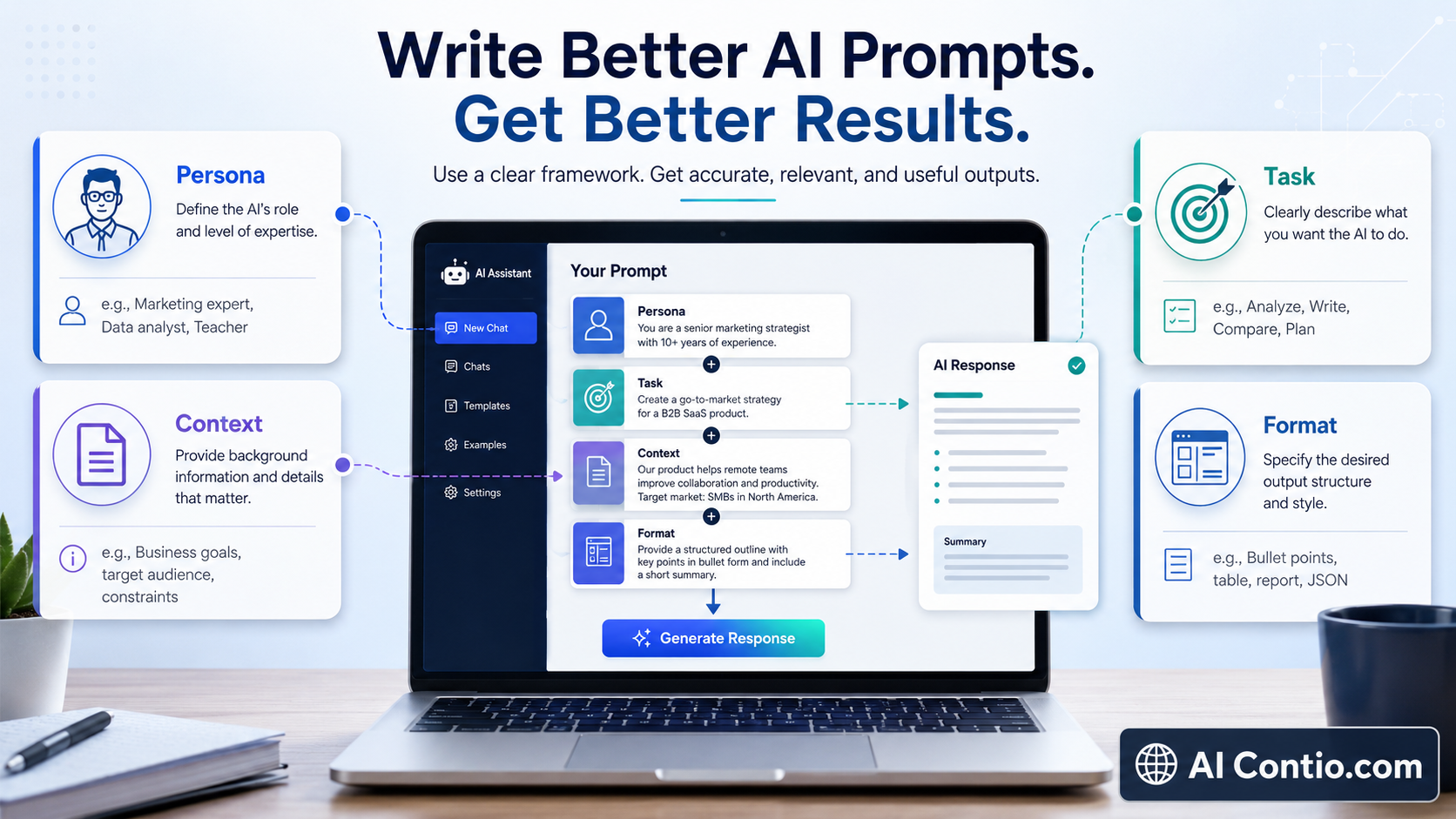
There is no single “right” way to prompt AI.
You don’t need special syntax. You don’t need to memorize magic words. And you certainly don’t need to become a professional “prompt engineer” before AI can be useful.
You mostly need to do something humans have been doing forever:
Explain clearly what you want.
Think about giving an assignment to a smart employee who knows a lot, but doesn’t necessarily know what is in your head. The better the instructions and background you give them, the better the result you’re likely to get.
A useful prompt generally contains four things:
| Component | What it means | Example |
|---|---|---|
| Persona | The expertise or perspective you want AI to draw from | You are a seasoned advertising writer |
| Task | What you want AI to do | Create a concise tagline |
| Context | The background information AI needs | The refrigerator’s features |
| Format | How you want the answer presented | Active voice, no more than six words |
Put those pieces together and you get something like this:
You are a seasoned advertising writer. Create a concise tagline for a new refrigerator. The refrigerator has an ice maker, two upper doors and two lower freezer drawers. Use active voice and keep the tagline to no more than six words.
That’s prompting.
No secret incantation required.
1. Give AI a Persona
Telling AI what role it should play helps establish the perspective you want it to take.
Instead of:
Help me write an advertisement.
Try:
You are an experienced advertising copywriter specializing in consumer appliances.
The persona doesn’t magically give the AI new knowledge. It gives it direction.
You could just as easily say:
- You are a CFO reviewing this business plan.
- You are an employment attorney reviewing this policy.
- You are a skeptical prospective customer evaluating this sales pitch.
- You are a high school teacher explaining this concept to a student.
Different perspectives can produce very different answers.
2. Clearly State the Task
Tell AI exactly what you want it to do.
“Help me with this” isn’t much of an assignment.
Neither is:
Make this better.
Better how?
Shorter? More persuasive? Friendlier? More professional? Easier to understand?
Instead, say:
Rewrite this email to make it shorter and more conversational while preserving the main argument.
Or:
Identify the three weakest arguments in this proposal and explain why a prospective customer might object to them.
The more clearly you define the job, the less AI has to guess.
3. Provide Context
Context is one of the most overlooked parts of prompting.
AI knows an enormous amount about the world.
What it doesn’t automatically know is your situation.
Suppose you ask:
Write an email promoting our new AI receptionist.
AI can certainly produce an email.
But now add:
Our customers are small HVAC companies with 10–50 employees. Most lose calls after hours and don’t want to hire another full-time receptionist. The AI receptionist answers those calls, qualifies the customer, and books appointments in their existing scheduling system.
Suddenly the AI has something useful to work with.
Good context might include:
- Who the audience is
- What you’re selling
- What problem you’re trying to solve
- What has already happened
- What constraints exist
- Examples of things you like or dislike
- Information the AI shouldn’t assume
The goal isn’t to tell AI everything you know.
It’s to give it everything relevant to the assignment.
4. Specify the Format
Finally, tell AI what the finished product should look like.
For example:
Give me five options.
Put the results in a table.
Write three paragraphs.
Use bullet points.
Keep it under 150 words.
Write at an eighth-grade reading level.
Use active voice.
Don’t use jargon.
Formatting instructions are particularly useful because otherwise AI has to decide for itself how much to write and how to organize the answer.
And as anyone who has used ChatGPT knows, AI is perfectly capable of answering a two-sentence question with a twelve-section strategic framework if you let it.
Three Rules for Better Prompts – The Three C’s.
The framework is useful, but there are three broader principles worth remembering.
Be Concise
More prompt isn’t necessarily better prompt.
Give AI enough information to understand the assignment, but don’t bury the important instructions inside paragraphs of unnecessary detail.
Start simple.
You can always add more information if the first result isn’t what you wanted.
Be Clear
Avoid vague or contradictory instructions.
Instead of:
Make this sound better but don’t change it very much and make it more detailed but shorter.
Decide what matters most.
For example:
Shorten this by about 25% while keeping the conversational tone and preserving all of the major points.
AI performs much better when it doesn’t have to decide which of your instructions matters most.
Be Consistent
Use the same vocabulary for the same things throughout a conversation.
If you’re calling someone the customer, don’t suddenly start referring to that person as the client, prospect, user, and account holder unless those words mean different things.
Consistency reduces ambiguity.
You Don’t Have to Get It Right the First Time
This may be the most important lesson.
A prompt isn’t a computer program.
You don’t have to perfectly specify everything before pressing Enter.
If the first answer isn’t quite right, tell AI what you want changed.
That’s too formal. Make it more conversational.
Option three is closest. Give me five more like that.
You’re focusing too much on cost savings. Rewrite it around revenue growth.
Cut this in half.
Prompting should usually be a conversation, not a one-shot command.
In fact, one of the easiest ways to get better at prompting is simply to critique the result.
Pro Tip: Build a Prompt Library
As you use AI more frequently, you’ll discover prompts and instructions that consistently produce good results.
Save them.
You might eventually have reusable prompts for:
- Writing LinkedIn posts
- Reviewing contracts
- Preparing for sales calls
- Summarizing meetings
- Analyzing spreadsheets
- Creating customer proposals
- Brainstorming marketing ideas
- Reviewing your own writing
You don’t necessarily need a sophisticated prompt-management system. A document or notes file is often enough.
Over time, those prompts become operating procedures for working with AI.
The Bigger Lesson
Prompting isn’t really about learning how to talk to a computer.
It’s about learning how to define what you want.
Give AI a role.
Give it a task.
Give it the relevant context.
Tell it what the finished product should look like.
Then look at what it gives you and continue the conversation.
That’s a good prompt.
And if the answer isn’t good?
Don’t immediately blame the AI.
Take another look at the assignment you gave it.