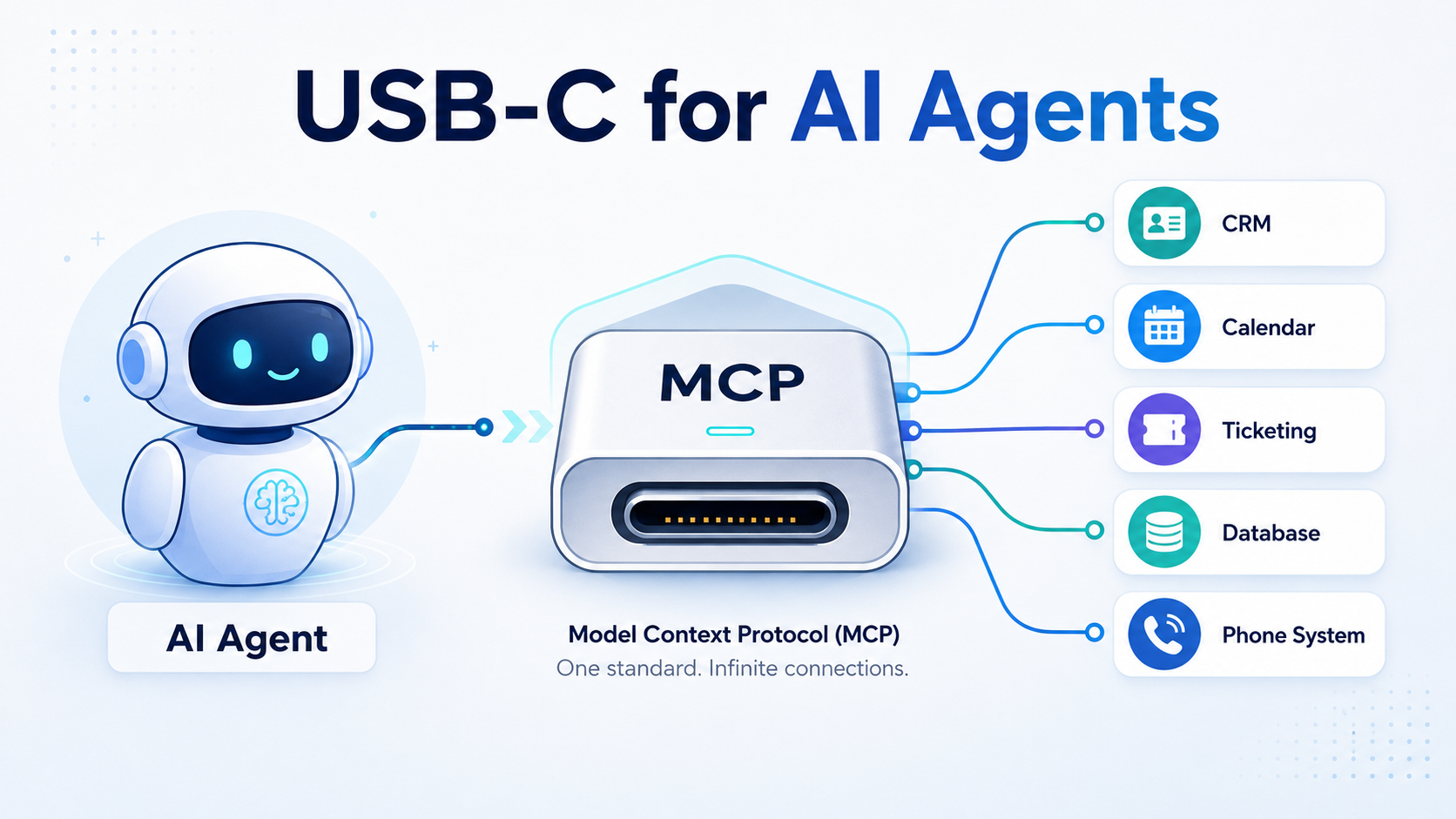
MCP stands for Model Context Protocol.
That sounds more complicated than it is.
At a basic level, MCP is a standard way for an AI application to connect to outside tools, data, and systems. The official MCP documentation describes it as an open-source standard for connecting AI applications to external systems: files, databases, tools, workflows, APIs, and other services. Anthropic introduced MCP in November 2024 as an open standard for building secure, two-way connections between AI-powered tools and data sources.
The easiest analogy is this:
MCP is like a USB-C port for AI agents.
Before USB-C, every device had its own cable, charger, adapter, and weird little connector. You had one cable for the camera, another for the printer, another for the phone, another for the laptop, and usually the one you needed was the one you forgot.
MCP is trying to solve a similar problem for AI.
Without a standard like MCP, every AI application has to build custom integrations to every external system it wants to use. One integration for Google Drive. Another for Salesforce. Another for GitHub. Another for Slack. Another for the CRM. Another for the ticketing system. Another for the internal database. Another for the phone system.
That works when the product is small, but does NOT scale.
MCP creates a more standardized pattern:
- An AI application acts as an MCP client.
- An external system exposes capabilities through an MCP server.
- The AI application can then discover and use those capabilities in a structured way.
Instead of every AI product needing to custom-build every integration, systems can expose MCP servers and AI applications can connect to them.
That is the promise.
Why MCP Exists
LLMs are very good at language. They can understand requests, summarize information, reason through ambiguity, and generate responses.
But by themselves, LLMs are not connected to the world.
They do not automatically know what is in your CRM. They cannot see your latest support tickets unless something gives them access. They cannot check whether a customer has an open invoice. They cannot book an appointment. They cannot update a spreadsheet. They cannot retrieve a call recording. They cannot look up a policy document in your internal knowledge base.
For an AI agent to be useful, it needs access to context and tools.
That is why tool calling became such an important part of AI application development. Tool calling lets a model do more than answer. It lets the model ask another system to do something.
For example:
“Look up this customer.”
“Check availability for next Tuesday.”
“Create a ticket.”
“Send a follow-up email.”
“Retrieve the last call summary.”
“Escalate this to a human.”
But tool calling alone does not solve the integration problem. It still leaves every developer defining tools, schemas, permissions, and connection logic separately.
MCP tries to standardize the connection layer.
It is not the model, the agent or the workflow. Instead, it is the protocol that lets the agent connect to tools and context in a more consistent way.
The Basic MCP Architecture
There are three main pieces to understand.
First, there is the MCP host. This is the AI application the user interacts with. It might be Claude Desktop, ChatGPT, an AI coding assistant, a custom enterprise agent, or a voice AI platform.
Second, there is the MCP client. This is the part of the AI application that knows how to speak MCP. It manages the connection to one or more MCP servers.
Third, there is the MCP server. This is the piece that exposes a system’s capabilities to the AI application. A server might connect to a database, a file system, a CRM, a documentation library, a calendar, a ticketing system, or a telecom platform.
OpenAI’s developer documentation now describes MCP and connectors as a way to give models new capabilities through remote MCP servers, alongside function calling and hosted tools. Microsoft has also adopted MCP in Copilot Studio and Windows-related AI work, describing it as a standard way to bring external tools, data, and knowledge into AI applications.
Adoption matters.
MCP started in the Anthropic ecosystem, but it is no longer just an Anthropic thing. It is becoming part of the broader AI agent infrastructure conversation.
A Simple Example
Imagine a support agent for a home services company.
A customer calls and says:
“I had a technician out last week and the problem is back. Can someone come tomorrow?”
The AI agent needs more than a good conversational model.
It needs to know:
Who is the customer?
What was the prior job?
Was it completed?
Was there a warranty?
What service area is the customer in?
What technicians are available tomorrow?
What appointment windows are open?
What should happen if this is a complaint or callback?
Should the agent book, escalate, or create a ticket?
Without integrations, the AI can only talk.
With integrations, the AI can act. This gives the AI “hands”.
An MCP server could expose capabilities like:
Look up customer by phone number.
Retrieve recent jobs.
Check service area.
Find available appointment slots.
Create a callback ticket.
Send confirmation.
Escalate to dispatcher.
The voice agent does not need to know the internal details of the CRM, scheduling system, or ticketing software. It needs a reliable way to discover and call the right tools.
That is where MCP fits.
Why MCP Matters for Voice AI
Voice AI makes the need for clean tool integration even more urgent.
In a chat interface, a delay is annoying, but certainly tolerable. You get a little ‘ding’ when the AI responds. But in a phone call, a delay feels broken.
In a chat interface, the user can see the system thinking, loading, or retrieving.
In a phone call, silence is expensive. Every extra second erodes trust.
Voice AI agents need to interact with external systems quickly, reliably, and safely. They also need to recover when tools fail.
That means the connection layer matters.
A voice agent that can speak fluently but cannot reliably check availability is not a production agent. It is a demo.
A voice agent that can answer questions but cannot distinguish between “create an appointment,” “request a callback,” and “escalate this complaint” is not ready for the real world.
A voice agent that has access to too many tools, with unclear boundaries, is dangerous.
MCP is important because it points toward a world where agents can connect to operational systems through standard interfaces instead of one-off custom wiring.
But MCP does not magically solve the hard parts of Voice AI.
It does not decide when the agent should call a tool.
It does not determine how the agent should handle an angry caller.
It does not automatically solve latency.
It does not guarantee identity, authorization, security, observability, or error recovery.
It gives us a standard connector pattern.
The production system still has to be designed.
MCP Is Not the Same as an API
This is a common source of confusion.
An API is usually built for software to call software.
MCP is built so AI applications can discover and use tools and context in a model-friendly way.
That distinction matters.
Traditional APIs often assume the developer knows exactly which endpoint to call and when. The developer reads the API documentation, writes code, handles the response, and builds the application logic.
MCP is more agent-oriented. It exposes tools, resources, and prompts in a way that an AI application can inspect and use.
That does not mean MCP replaces APIs.
In many cases, an MCP server is a wrapper around one or more existing APIs.
The CRM already has an API. The calendar already has an API. The ticketing system already has an API. The MCP server sits between the AI application and those APIs, exposing selected capabilities in a standard format.
So MCP is not “instead of APIs.”
It is often an AI-native layer on top of APIs.
Tools, Resources, and Prompts
MCP commonly organizes capabilities into a few broad categories.
Tools are actions the AI can ask the system to perform. For example, search records, create a ticket, schedule an appointment, send a message, or retrieve account status.
Resources are pieces of context the AI can read. For example, documents, database records, files, call transcripts, product information, or customer history.
Prompts are reusable prompt templates or workflows exposed by the server.
This is important because it moves us away from the idea that the model should just “know everything.”
Instead, the model can be given access to the right context at the right time.
That is a healthier architecture.
The agent does not need every document dumped into the prompt. It needs the ability to retrieve the relevant document when the conversation requires it.
The agent does not need every customer record in context. It needs permission to retrieve the right customer record after identity is established.
The agent does not need a giant prompt that describes every possible workflow. It needs clearly defined tools and policies for when those tools should be used.
The Big Benefit: Fewer One-Off Integrations
The biggest practical benefit of MCP is reducing integration fragmentation.
Today, the AI agent ecosystem has a serious “N x M” problem.
If there are N AI applications and M external tools, every AI application has to figure out how to connect to every tool.
That creates duplicated work, inconsistent behavior, security gaps, and brittle integrations.
MCP offers a cleaner pattern.
A system can expose an MCP server once.
Multiple AI applications can connect to it.
The same server can support different clients, different models, and different agent experiences.
This is why the market is paying attention. MCP gives SaaS companies, enterprise software vendors, and internal platform teams a way to make their systems more accessible to AI agents without building a custom integration for every AI interface.
That is the right direction.
The Catch: Standard Access Is Not the Same as Safe Action
Here is where the hype gets ahead of reality.
Giving an AI agent access to a tool is not the same thing as making the agent reliable.
In fact, MCP can make unsafe systems easier to build if teams treat it as magic.
Once an agent can “have hands,” the security model changes.
The agent is no longer just answering questions.
- It can retrieve private information.
- It can take actions.
- It can modify records.
- It can send messages.
- It can trigger workflows.
- It can move money, approve changes, delete data, or expose sensitive context if the system allows it.
That means MCP servers need strong boundaries.
- What can the agent read?
- What can it write?
- Which user is it acting on behalf of?
- What permissions does that user have?
- Does the tool require confirmation?
- Is there an audit log?
- Can the system detect unusual tool use?
- What happens if the model is tricked?
- What happens if a tool description itself contains malicious instructions?
Security researchers have already been studying MCP-related risks, including prompt injection, tool poisoning, and weak client-side validation. One 2026 paper specifically identifies tool poisoning, where malicious instructions are embedded in tool metadata, as a major MCP security concern.
That does not mean MCP is bad.
It means MCP should be treated like infrastructure.
And infrastructure needs security, identity, observability, testing, and governance.
What the agent does with those tools is still the hard part.
The Voice AI Version of the Security Problem
In voice, the risk is not abstract.
A caller might say:
- “Can you change my appointment?”
- “Can you send me the invoice?”
- “Can you update my address?”
- “Can you cancel my service?”
- “Can you transfer me to billing?”
- “Can you tell me what notes are on my account?”
Each one of those requests may require access to operational systems.
- Some are harmless.
- Some are sensitive.
- Some should require verification.
- Some should be escalated.
- Some should be logged.
- Some should never be performed by an AI agent without human review.
This is why I think MCP matters, but I also think it needs to be put in the right box.
MCP can help the agent connect.
- It does not replace the need for an agent constitution.
- It does not replace policy.
- It does not replace authentication.
- It does not replace escalation rules.
- It does not replace call observability.
- It does not replace testing.
The agent still needs to know what it is allowed to do, when it must ask for confirmation, when it must escalate, and how it should recover when a tool fails.
MCP and Observability
One of the less glamorous but more important questions is this:
Can you see what happened?
For production AI agents, especially voice agents, observability is not optional.
You need to know:
- Which tools were available?
- Which tool did the agent choose?
- What arguments did it pass?
- How long did the tool call take?
- What came back?
- Did the tool fail?
- Did the agent recover?
- Did the caller hear silence?
- Did the agent summarize the result correctly?
- Did the agent take an action it should not have taken?
MCP standardizes a way to connect, but production teams still need logging, tracing, replay, version control, evaluation, and alerting around the agent’s behavior.
Without that, MCP can make the system feel cleaner from an integration standpoint while making failures harder to diagnose.
A failed call is rarely just “the model got it wrong.”
- It might be a tool schema issue.
- It might be a permissions issue.
- It might be a timeout.
- It might be bad context retrieval.
- It might be an ambiguous tool description.
- It might be a downstream API change.
- It might be the agent calling the right tool at the wrong time.
If you cannot see the tool path, you cannot fix the agent.
MCP Is a Connector Layer, Not an Operating Model
This is probably the most important point.
MCP is not an agent operating system.
It is not a complete production framework.
It is not a business process.
It is not a customer experience strategy.
It is a protocol.
That is useful, but it is only one layer.
A real production agent needs several layers:
The conversation layer: What does the agent say? How does it handle ambiguity? How does it manage turn-taking?
The reasoning layer: What does the agent infer? When does it decide it has enough information?
The tool layer: What systems can the agent access? What actions can it take?
The policy layer: What is the agent allowed to do? What requires confirmation? What requires escalation?
The identity layer: Who is the user? What permissions apply?
The observability layer: What happened, when, why, and how do we debug it?
The evaluation layer: How do we test regressions, prompt drift, tool failures, and edge cases?
MCP helps with the tool and context layer.
It does not eliminate the others.
Why Business Leaders Should Care
For business leaders, MCP matters because it changes the integration conversation.
The question is no longer just:
“Does your product have an API?”
The question becomes:
“Can your product be safely used by AI agents?”
That is a different bar.
A product with an API can be integrated by developers.
A product with a well-designed MCP server can be discovered and used by AI applications more easily.
But “easily” is not enough.
The better question is:
Can the agent use it safely, with the right permissions, the right context, the right limits, and the right audit trail?
For SaaS companies, MCP may become part of the product surface area. Just as APIs became a sign of enterprise readiness, MCP servers may become a sign of agent readiness.
For AI application builders, MCP may reduce integration work and make agent systems more modular.
For enterprises, MCP may help standardize how internal tools are exposed to AI systems.
For Voice AI platforms, MCP may become one of the ways agents connect into CRMs, calendars, support systems, ticketing platforms, and telecom infrastructure.
But none of this removes the need for careful system design.
A Practical Definition
Here is the simplest definition:
MCP is an open standard that lets AI applications connect to external tools, data, and workflows through a common protocol.
A more practical version:
MCP is a standardized way to give AI agents controlled access to the systems they need in order to do useful work.
And the Voice AI version:
MCP is one possible bridge between a talking agent and the operational systems behind the business.
That bridge matters.
But bridges still need guardrails.
The Bottom Line
MCP is important because AI agents need more than language.
- They need context.
- They need tools.
- They need access to systems.
- They need a standard way to connect.
MCP gives the industry a shared pattern for that connection.
That is a big deal.
But MCP does not make an agent production-ready by itself.
It does not solve prompt design.
It does not solve voice behavior.
It does not solve latency.
It does not solve identity.
It does not solve security.
It does not solve escalation.
It does not solve observability.
It does not solve business process design.
It gives the agent a cleaner way to reach the tools.
What the agent does with those tools is still the hard part.
And in Voice AI, that hard part is where most of the real work lives.
#AI #LLM #MCP #mcp vs api #what is mcp