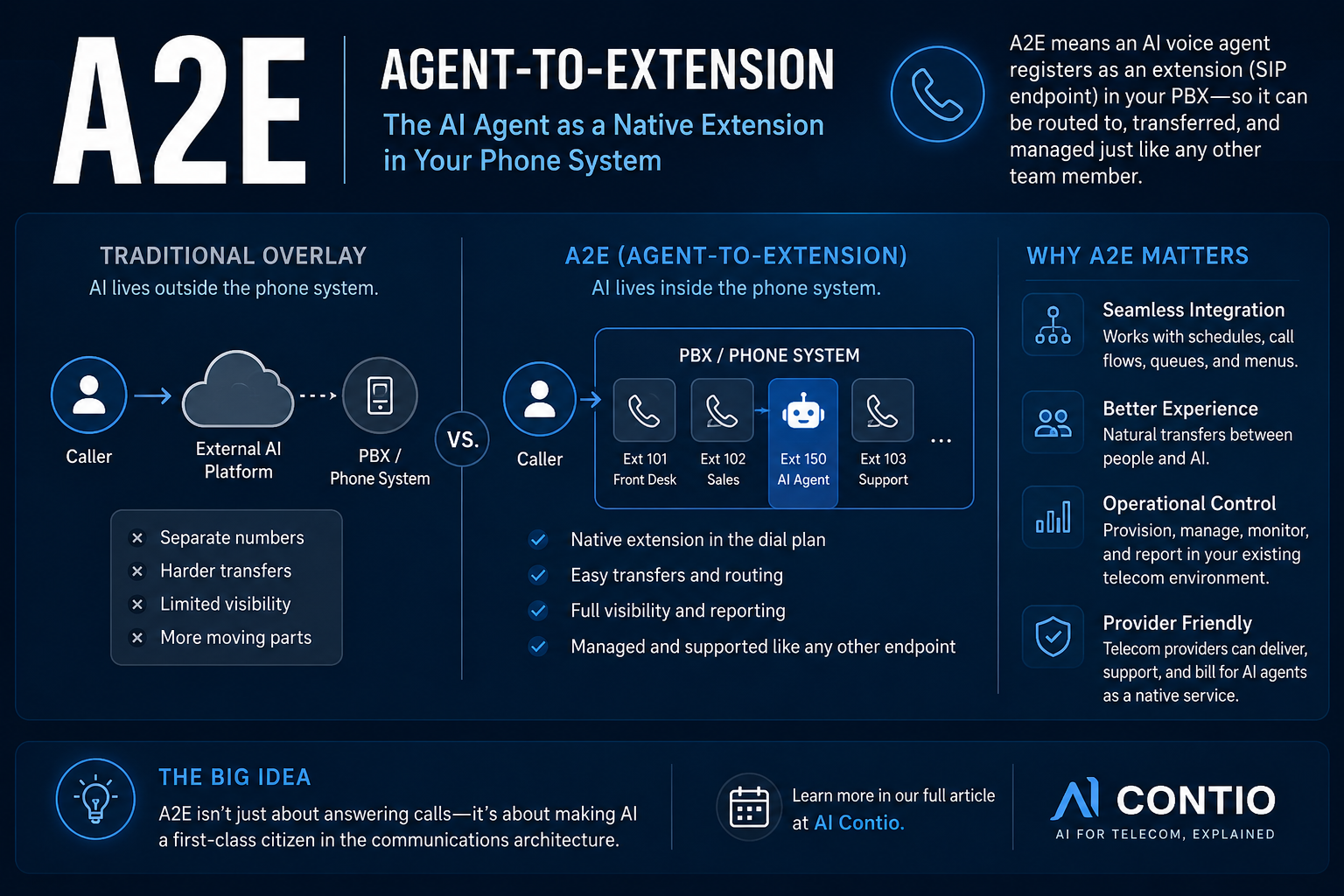
When the AI Agent Becomes a Phone Extension
Most Voice AI terms sound more complicated than they really are.
A2P means application-to-person messaging. A2A means agent-to-agent communication. MCP means a model or agent can connect to tools and context.
And now we are starting to see another term show up in the Voice AI and telecom world:
A2E: Agent-to-Extension.
At its simplest, A2E means that an AI voice agent can be treated like a normal extension inside a phone system. It is not a separate app or a bolt-on widget. It is not a phone number sitting outside the company’s existing call flow.
It is an extension on the current existing phone system (PBX).
To the PBX, the AI agent looks like another endpoint. To the customer, it behaves like another member of the team. To the business, it can be routed, transferred to, provisioned, monitored, and potentially billed in a way that already makes sense to telecom operators and business phone system providers.
A2E, or Agent-to-Extension, is a Voice AI deployment model where an AI agent functions as a native extension or endpoint inside a phone system.
A2E is one of those terms that matters because it changes where Voice AI sits in the architecture. And in telecom, where something sits usually determines how useful it can become. An AI that only lives behind a phone number now has limited options on how calls can be transferred to/from it. But an AI that is a native part of the PBX is now as flexible as the PBX itself.
The simple definition
A2E, or Agent-to-Extension, is a deployment model where an AI voice agent registers or behaves as an extension inside an existing phone system.
That means the agent can potentially be reached the same way a person, desk phone, softphone, call queue, voicemail box, auto attendant, or department extension can be reached.
In a traditional office phone system, you might have:
Extension 7101: front desk
Extension 7102: sales
Extension 7103: service
Extension 7104: billing
In an A2E model, you might also have:
Extension 7150: after-hours AI receptionist
Extension 7151: appointment booking agent
Extension 7152: overflow intake agent
Extension 7153: Spanish-language support agent
The important shift is that the AI agent is not merely answering a separate phone number. It becomes part of the dial plan, and that distinction matters.
A lot of current Voice AI deployments are effectively “phone number first” deployments. A business forwards calls to an AI agent, or buys a new number that routes directly to an AI platform. That can work, especially for pilots and simple use cases. But it often means the Voice AI system lives adjacent to the phone system rather than inside it.
A2E says: what if the agent is just another endpoint?
Why A2E matters
The reason A2E matters is not because “extension” is a glamorous word. It is because the extension is one of the most basic building blocks of business telephony.
Businesses already understand extensions, and phone providers already know how to provision extensions. PBX systems already know how to route calls to extensions, and billing systems already know how to associate services with extensions, seats, departments, or users. Administrators already know how to put extensions into ring groups, queues, call flows, menus, and schedules.
So when an AI agent becomes an extension, Voice AI starts to fit into existing telecom operations instead of forcing everyone to build around a separate AI product.
That is the big idea.
A2E is not really about the model. It is not about whether the agent uses GPT, Claude, Gemini, Llama, or something else. It is not even primarily about whether the voice sounds human.
A2E is about integration.
It answers the question: How does this AI agent live inside the communication system the business already uses?
The difference between A2E and a typical Voice AI overlay
A lot of Voice AI products today are deployed as overlays.
That is not automatically bad. In fact, overlays are often the fastest way to get started. You point a number at the AI provider. You test the agent. You see whether callers can complete the desired task. You measure containment, transfer quality, appointment booking, lead capture, and other business outcomes, but overlays have limits. In an overlay setup, the AI platform may own the call entry point. The business may need to change forwarding rules. The telecom provider may lose visibility into what happened. Transfers may require extra configuration. Reporting may live in a different dashboard. The call flow may become harder to troubleshoot because part of it is in the PBX and part of it is somewhere else.
In an A2E model, the AI agent is more native to the phone environment.
The PBX can route to it. A receptionist can transfer to it. A queue can overflow to it. An auto attendant can send certain menu options to it. A schedule can determine whether calls go to a human team during business hours and to the AI agent after hours.
The difference is subtle but important.
An overlay says: “Send calls out to this AI system.”
A2E says: “This AI system is part of the phone system.”
That difference affects trust, control, observability, support, billing, and ultimately adoption.
A practical example
Imagine a local HVAC company.
Today, its phone system has a main number, a business-hours schedule, a voicemail box, a few mobile users, and maybe an answering service for nights and weekends.
A customer calls at 8:30 p.m. because the air conditioning is out.
In a traditional setup, the call may go to voicemail or an answering service. The customer may wait for a callback. The business may lose the job to the company that answers first.
In a basic Voice AI overlay, the business might forward after-hours calls to an AI agent. The agent answers, asks what is wrong, collects the customer’s name, address, issue, and urgency, and sends the lead to the team.
That is useful.
In an A2E model, the agent might be extension 7250 inside the company’s phone system.
The after-hours schedule routes calls to extension 7250. If the caller has an emergency, the AI agent can transfer to the on-call technician. If the caller is an existing customer, it can collect account details. If the customer wants a non-emergency appointment, it can book or create a service request. During business hours, a human dispatcher could transfer overflow calls to extension 250 when the phones get busy.
The agent is no longer just “the AI number,” instead, it is part of the phone system’s operating model.
Why telecom providers should care
A2E is especially important for hosted PBX, UCaaS, CPaaS, and managed telecom providers.
The Voice AI market has been moving quickly, and many of the early winners have been AI-first companies. They are good at demos, prompt configuration, voice selection, and fast iteration. But many of them are still learning telecom.
Telecom providers have the opposite problem. They already own the phone numbers, routing, SIP infrastructure, customer relationships, billing models, call detail records, compliance workflows, support processes, and channel relationships. But many of them have been slower to package Voice AI as a native product.
A2E gives telecom providers a more natural path.
Instead of treating Voice AI as a scary replacement for the phone system, they can treat it as a new kind of endpoint.
That framing matters.
Telecom has sold endpoints for decades: desk phones, softphones, mobile apps, conference bridges, call queues, contact center seats, auto attendants, voicemail boxes, and users.
A2E says the AI agent is another endpoint. Not necessarily a human seat. Not necessarily a traditional license. But an addressable, provisionable, routable part of the customer’s communications environment.
That could be a much better mental model than trying to jam AI agents into old seat-based pricing.
A2E versus A2A
It is worth separating A2E from A2A.
A2A means Agent-to-Agent. It is about agents communicating with other agents. For example, a customer service agent might talk to a billing agent, an inventory agent, or a scheduling agent to complete a task.
A2E means Agent-to-Extension. It is about an agent existing as a telephony endpoint inside a phone system.
They solve different problems.
A2A is an interoperability problem: can agents discover each other, exchange information, coordinate tasks, and work across systems?
A2E is a telecom integration problem: can a voice agent behave like a native extension in the business phone environment?
In practice, the two may eventually work together.
A customer might call a Voice AI agent that is deployed as an extension. That A2E agent might then communicate with other agents using A2A-style patterns. It could ask a scheduling agent for availability, a CRM agent for customer history, a billing agent for account status, or a dispatch agent for technician coverage.
But the caller does not care about any of that.
The caller just wants the phone answered and the problem solved.
That is why A2E is such a practical term. It starts with the communication experience rather than the abstract agent ecosystem.
Why “native” matters
In Voice AI, a lot of failures happen at the seams.
- The AI can talk, but the transfer fails.
- The AI collects the right information, but the CRM does not update.
- The AI books an appointment, but the calendar does not reflect the real technician schedule.
- The AI handles the call well, but the business has no easy way to see what happened.
- The AI works in a demo, but breaks when inserted into the real call flow.
Those are not usually model problems.
They are integration problems.
A2E does not magically solve all of them, but it points in the right direction. It says the AI agent should be operationally native to the phone system, not just conversationally impressive. Instead, it means builders need to think about questions like:
- Can the agent be provisioned like an extension?
- Can calls be routed to it based on schedules, queues, menus, overflow, or business rules?
- Can humans transfer calls to and from it naturally?
- Can the system preserve caller ID, call context, recording rules, and reporting?
- Can the telecom provider see enough to support the customer when something goes wrong?
- Can the business manage the agent without needing to understand the entire AI stack?
This is the unglamorous part of Voice AI.
It is also the part that determines whether the product survives contact with the real world.
The risk: calling everything A2E
As with any new term, there is a risk that A2E becomes marketing fog.
A vendor could say “Agent-to-Extension” and simply mean, “We can receive a forwarded call.”
That is not enough.
To be meaningful, A2E should imply more than call forwarding. It should imply some degree of native telephony behavior.
At minimum, I would expect a real A2E implementation to support some combination of:
- SIP registration or SIP endpoint-style behavior
- Extension-level addressing
- PBX routing integration
- Transfer support
- Caller ID handling
- Business-hours routing
- Call detail visibility
- Provisioning and management through the telecom provider or PBX admin experience
- Reporting that connects AI activity to call activity
Not every product will support all of that on day one. But if the agent is not manageable as part of the phone system, the term “Agent-to-Extension” becomes less useful.
The whole point is not that the AI answers calls.
The point is that the AI becomes part of the call architecture.
What A2E means for buyers
If you are a business evaluating Voice AI, A2E gives you a useful question to ask:
Will this AI agent work inside my existing phone system, or will I have to route around my existing phone system?
That one question can reveal a lot.
If the AI agent sits outside your phone system, that may be fine for a pilot. But you should understand the tradeoffs. Who owns the number? How are transfers handled? Can you use your existing business-hours rules? Will your team see the call history? What happens if the AI needs to send the caller to a human? Who supports the call if something breaks?
If the AI agent can act as an extension, the deployment may be cleaner. Your existing call flow can stay intact. Your team can route to the agent the same way they route to people or departments. Your telecom provider may be able to support it more naturally. You may have a simpler path from experiment to production.
Again, A2E is not automatically better in every case.
But it is a sign that the vendor understands the operational reality of business telephony.
What A2E means for builders
For Voice AI builders, A2E is a reminder that product strategy should not stop at the conversation.
A great voice agent is not just a prompt with a nice voice.
It is an endpoint in a communications workflow.
That means the product has to respect the things telecom people already know are hard: routing, failover, latency, DTMF, SIP behavior, caller ID, transfers, call recording, compliance, emergency handling, number ownership, and support visibility.
A2E is a sign that Voice AI is moving from demo-layer novelty to telecom-native infrastructure.
The model is only one piece.
The agent’s place in the phone system may matter just as much.
This is also where Voice AI companies and telecom providers may need each other. AI-first companies often move faster on agent design and conversational experience. Telecom providers already have distribution, infrastructure, numbers, customers, and trust.
A2E could be one of the bridges between those worlds.
The bigger shift
The deeper reason A2E matters is that it changes the role of the phone system.
For years, the phone system connected humans to humans. Then it connected humans to menus. Then it connected humans to queues, apps, CRMs, and contact center workflows. Now it is beginning to connect humans to agents.
That does not mean every call should be automated. It does not mean businesses should hide humans behind AI. It does not mean the AI should pretend to be a person. It means the phone system is becoming an orchestration layer for both human and AI labor.
Some calls should go to people. In some companies, a large number of calls go directly to an extension. The caller already knows they want to reach Mike at extension 7001. An A2E configuration makes that a simple on-PBX transfer.
Some calls should go to AI. Maybe support. Maybe appointment scheduling. Maybe sales pre-qualification.
Some calls should start with AI and escalate to people. Some calls should start with people and hand off a structured task to AI.
Some calls may eventually move between multiple agents and systems before they are resolved.
A2E is one practical piece of that transition. And having it a configured part of an existing PBX, makes that easy.
It gives the AI agent an address.
It gives the phone system a way to route to it.
And it gives businesses a more familiar way to adopt Voice AI without rebuilding their communications stack from scratch. No forklift upgrade.
Final definition
So, what is A2E?
A2E, or Agent-to-Extension, is a Voice AI deployment model where an AI agent functions as a native extension or endpoint inside a phone system.
The simple version:
The AI agent gets a place in the dial plan.
The more important version:
A2E is a sign that Voice AI is moving from demo-layer novelty to telecom-native infrastructure.
And that is where this market has to go.
Because the future of Voice AI will not be won by the agent that sounds the most impressive in a sandbox.
It will be won by the agent that works inside the messy, existing, operational phone systems businesses already rely on every day.
#A2A #A2E #AI #AI Voice #LLM #SimplyAI #Voice AI