Most conversations about voice AI center on prompts and models. Almost nobody talks about what happens when something breaks.
An API times out. A calendar booking fails. A transfer doesn’t complete. The CRM goes unavailable. The knowledge base doesn’t respond. These aren’t edge cases. In production, they’re routine.
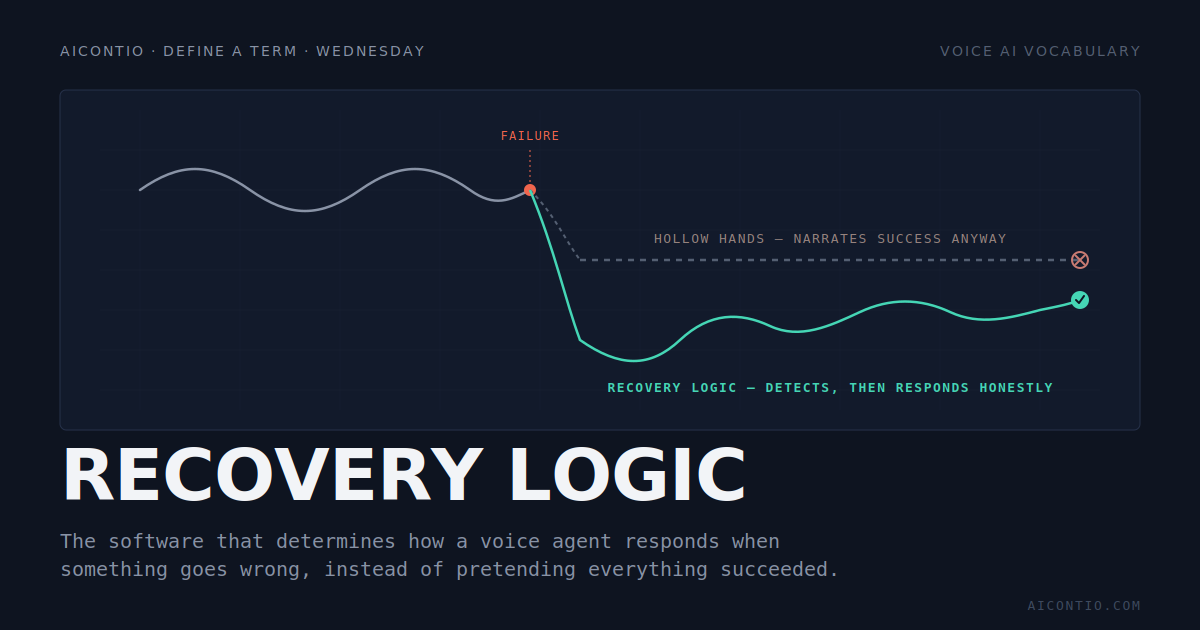
Recovery logic is the software that determines how a voice agent responds when something goes wrong, instead of pretending everything succeeded.
Recovery logic lives at two different layers, and separating them matters:
At the craft layer, recovery logic is the fallback language an operator writes into the prompt: what the agent says when a lookup fails, how it escalates, whether it offers a human handoff or a callback. This is fixable without touching the platform.
At the platform layer, recovery logic is whether a failure is even detected and surfaced to the model in the first place. If a timeout or a failed API call never reaches the agent as an event, no amount of prompt engineering will produce the right response. The model can’t recover from a failure it was never told about.
This is where recovery logic connects directly to hollow hands. An agent with no recovery logic doesn’t just fail quietly. It narrates success anyway, confirming a booking that never wrote to the calendar, or promising a transfer that silently dropped. The absence of recovery logic is what turns a backend error into a false promise heard by a customer.
Recovery logic is now one of the first things checked in every Behind the Call teardown. Not because it’s the most visible part of a voice agent, but because it’s the part that determines whether a failure stays contained or reaches the caller as a broken promise.
#AI Voice #recovery logic #Voice AI