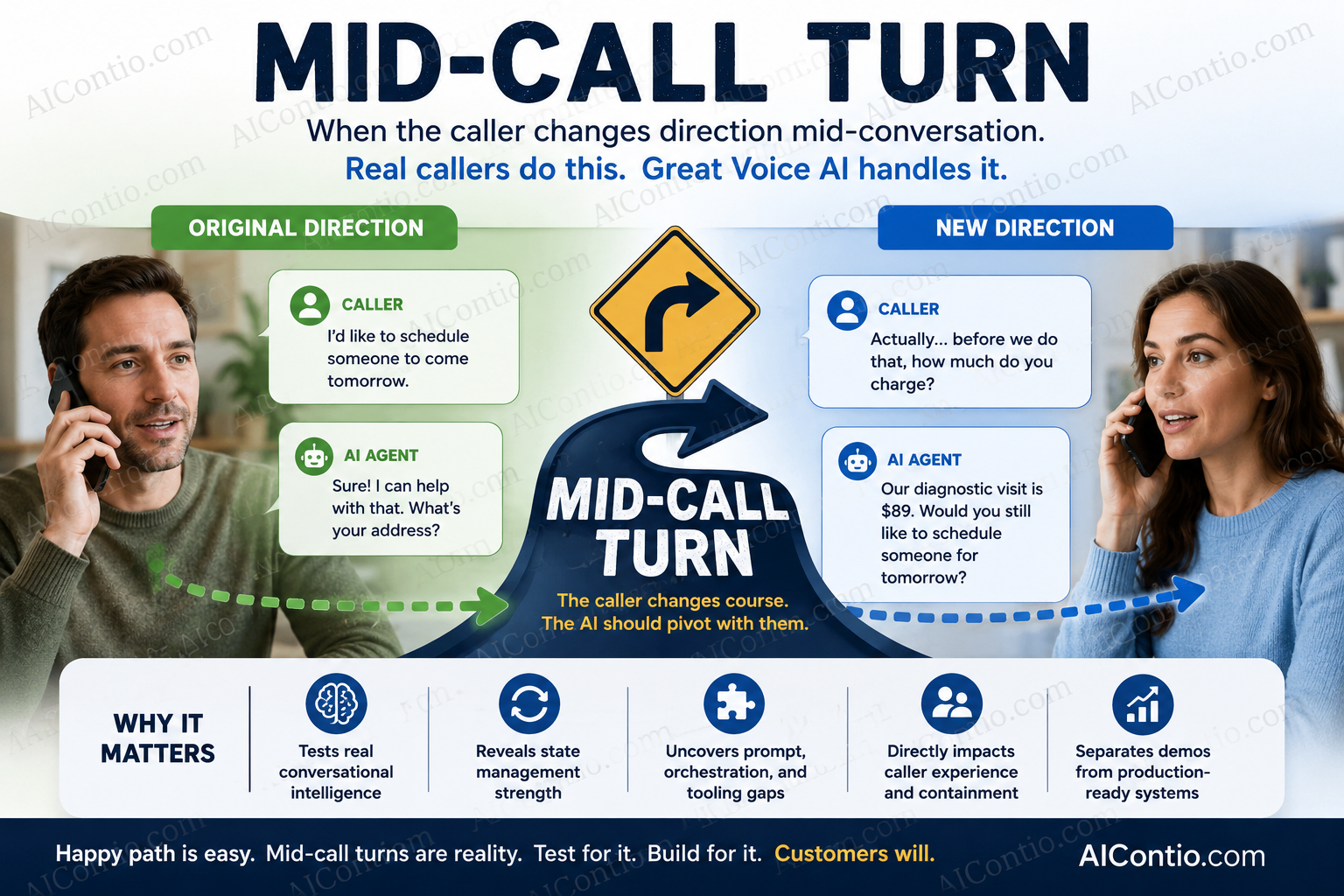
What Is a Mid-Call Turn?
Most Voice AI demos follow a script.
The caller asks for an appointment.
The AI schedules it.
Everyone leaves impressed.
Real callers don’t behave that way.
Halfway through the conversation they remember something, or they change their mind, or they ask a completely unrelated question.
Or they suddenly decide they don’t want what they originally called about.
I call these moments mid-call turns.
A mid-call turn happens whenever the caller changes the direction of the conversation after the AI has already committed to a particular task or workflow.
The ability to recognize and gracefully handle these changes is one of the clearest indicators of whether a Voice AI system is ready for production.
Examples of Mid-Call Turns
Imagine a plumbing company.
Caller:
I’d like to schedule someone to come tomorrow.
The AI begins collecting appointment information.
Then the caller says:
Actually…before we do that, how much do you charge?
That’s a mid-call turn.
Or perhaps:
Never mind. My landlord actually has to make this appointment.
Another turn.
Or:
Wait—I think I have your maintenance plan. Does that cover this?
Yet another.
Humans do this constantly.
We remember information.
We change priorities.
We interrupt ourselves.
We ask side questions.
A production-quality Voice AI has to follow those changes naturally.
Why Mid-Call Turns Are Difficult
Many Voice AI systems are built around a workflow.
Greeting
↓
Collect information
↓
Schedule appointment
↓
Confirm
↓
End call
That works beautifully…
…until the workflow suddenly becomes:
Greeting
↓
Collect information
↓
Customer changes topic
↓
Customer asks pricing
↓
Customer changes their mind
↓
Customer wants a transfer
↓
Resume original task
Suddenly the conversation isn’t linear anymore.
It’s dynamic.
The AI has to understand that the customer’s new request isn’t an interruption—it’s the new priority.
The Common Failure Modes
When I intentionally introduce a mid-call turn, I commonly see systems:
- Ignore the new request and continue the original workflow.
- Answer the new question but forget what they were doing.
- Restart the conversation from the beginning.
- Lose information the caller already provided.
- Continue as though the customer never changed directions.
Sometimes the AI simply becomes confused and starts apologizing repeatedly.
None of these feel natural.
Why Multi-Step Prompts Often Struggle
One pattern I’ve started noticing while testing Voice AI platforms is that mid-call turns tend to expose the weaknesses of highly structured, multi-step prompts.
Many prompt designs look something like this:
Ask for the customer’s name.
Don’t continue until you have it.
Then ask for their address.
Don’t continue until you have it.
Then ask for their email.
Don’t continue until you have it.
On paper, this feels organized. It’s easy to read and straightforward to build.
But real callers rarely cooperate with that structure.
Imagine the conversation:
AI: “May I have your address?”
Caller: “Actually…before we go any further, how much does this service cost?”
A surprising number of systems don’t know what to do next.
Some ignore the pricing question and ask for the address again.
Others answer the question but then restart the entire intake process.
Some simply lose their place altogether.
The problem isn’t the language model, it’s that the conversation has been designed as a checklist instead of a conversation.
Conversations Aren’t Forms
I’ve generally found that longer, more cohesive prompts tend to recover from these situations much more naturally.
Instead of thinking:
Collect Name → Collect Address → Collect Email
they’re guided by broader objectives such as:
- Gather enough information to schedule service.
- Answer customer questions whenever appropriate.
- Preserve previously collected information.
- If the caller changes direction, follow them.
- Resume the original task when it makes sense.
That gives the model room to behave more like a skilled receptionist than a web form with a microphone attached.
Ironically, these prompts are often longer, but they’re also more resilient because they describe the desired conversational behavior rather than a rigid sequence of individual steps.
What Good Looks Like
A strong Voice AI should behave much like a skilled human receptionist.
If the customer asks a side question, answer it.
If they change their objective, pivot gracefully.
If appropriate, return to the original task without making the customer repeat everything.
For example:
“Absolutely. Our diagnostic visit is $89. Now, would you still like to schedule someone for tomorrow?”
Notice what’s happening.
The AI answered the new question…
…remembered the previous context…
…and smoothly resumed the conversation.
That’s exactly what callers expect.
Why I Test This Every Time
One of the standard QA tests I perform for Voice AI systems is deliberately introducing one or more mid-call turns.
Not because I’m trying to trick the AI.
Because that’s what real customers do.
A system that performs flawlessly on the happy path may struggle the moment the conversation takes an unexpected turn.
The earlier those behaviors are identified, the easier they are to correct through prompt design, conversation architecture, tool orchestration, or workflow changes.
Final Thoughts
Large language models are remarkably good at conversation.
The challenge isn’t generating words.
The challenge is managing changing objectives while maintaining context.
That’s what happens in real conversations.
And that’s why I believe every production Voice AI system should be tested not only for the happy path, but for the inevitable mid-call turns that every real customer will eventually make.
#AI #AI Voice #AI Voice Agent #mid-call turn #Voice AI #Voice AI Term