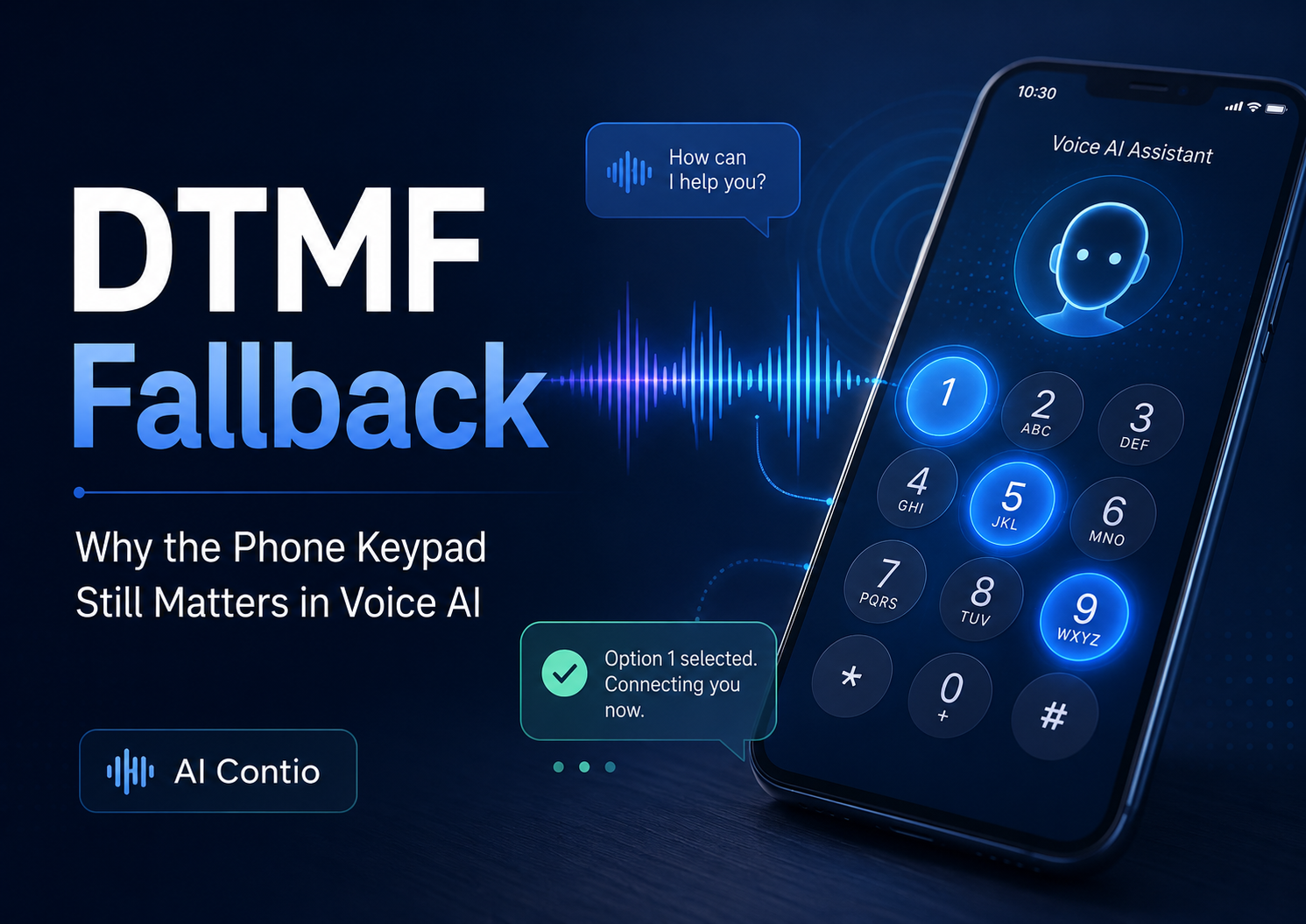
DTMF stands for Dual-Tone Multi-Frequency. That sounds like a complicated telecom term, but most people know it by a much simpler name: pressing buttons on a phone keypad.
When you hear “Press 1 for sales,” “Press 2 for support,” or “Enter your zip code,” you are using DTMF. Each key on the phone keypad produces a specific pair of tones. The phone system listens for those tones and uses them as input. (In some systems today the DTMF is sent as part of the data packet and not actual tones in the audio stream.)
For decades, DTMF was one of the core building blocks of automated phone systems. Before natural language voice agents, before speech recognition, before AI-powered call handling, phone systems relied heavily on keypad input. The caller pressed a number. The phone system detected the tone. The call moved to the next step.
In the age of Voice AI, it may be tempting to think of DTMF as old-fashioned. After all, the whole point of Voice AI is that callers can speak naturally instead of navigating rigid phone menus. The AI can understand intent, ask questions, gather information, answer common questions, and route calls more intelligently than a traditional IVR.
But DTMF is not obsolete.
In fact, DTMF fallback may become more important as Voice AI systems move from demos into real production environments.
DTMF fallback means giving the caller a keypad-based option when speech input is not the best way to complete a task. Instead of forcing every interaction through spoken language, the system can say something like, “You can say your zip code, or enter it on your keypad,” or “If you would rather not spell that out loud, you can press the numbers now.”
That does not mean the AI failed. It means the system is designed with reality in mind.
Real phone calls are messy. Callers are often in cars, kitchens, offices, job sites, waiting rooms, stores, or public places. There may be background noise, speakerphone distortion, poor mobile reception, road noise, kids in the background, other people talking, or a television playing nearby. What looks like an AI comprehension problem may actually be an audio quality problem.
There are also moments when voice is simply not the ideal input method. Speech recognition can be very good, but certain kinds of information are still hard to capture reliably by voice. Email addresses, confirmation codes, account numbers, addresses, zip codes, policy numbers, invoice numbers, and long strings of digits or letters can all create friction. The caller may say the information correctly, but the system may mishear it. The caller may need to repeat it. The AI may confirm it incorrectly. The interaction starts to feel slow and fragile. If the caller says “one hundred twenty-five” for example, do they mean a five digit number, e.g. 10025 or a three digit number – 125?
This is where DTMF fallback becomes useful.
For example, asking someone to say a five-digit zip code out loud may work most of the time. But letting them enter the zip code on the keypad may be faster, more private, and more reliable. The same may be true for the last four digits of a phone number, a simple menu choice, or a confirmation step.
The important design point is that DTMF should not be treated as a replacement for Voice AI. It should be treated as another input option. A mature Voice AI system should be able to use natural language where natural language is helpful, and use keypad input where keypad input is more reliable.
That distinction matters.
A poorly designed system forces the caller into one mode of interaction, even when that mode is not working. A better system adapts. If the caller is struggling to spell an email address, the system can offer another path. If the audio quality is poor, the system can simplify the interaction. If the task requires precision, the system can use the keypad as a confirmation mechanism.
This is especially important because caller patience is limited. Every repeated question, long pause, failed recognition, and incorrect confirmation spends from the caller’s patience budget. Once that patience is gone, the caller may ask for a human, press zero, hang up, or lose trust in the system.
DTMF fallback is one way to protect that patience budget.
It gives the caller a reliable escape hatch before the interaction breaks down. It also gives the system a way to recover gracefully when speech input becomes unreliable. In that sense, DTMF fallback is not a step backward. It is a resilience pattern.
The best Voice AI systems will not be “voice only.” They will be multimodal within the constraints of the phone call. Sometimes the best input is spoken language. Sometimes it is a keypad press. Sometimes it is a text message link. Sometimes it is a human transfer. The job of the system is not to prove that AI can handle everything by voice. The job is to complete the caller’s task with the least friction and the highest reliability.
This is also why DTMF fallback should be designed intentionally, not bolted on as an afterthought. Teams building Voice AI systems should decide where keypad input makes sense, what information is too fragile to capture only by voice, when to offer a fallback, and how to explain it to the caller without making the experience feel clunky.
For example, instead of saying, “I did not understand you,” the agent might say, “That kind of information can be easy to mishear. You can enter the five digits on your keypad if that is easier.” That framing preserves trust. It makes the fallback feel helpful rather than punitive.
The larger lesson is that good Voice AI is not about eliminating every older technology from the call flow. It is about using the right tool at the right moment.
DTMF has been around for a long time. But in Voice AI, its continued usefulness is a reminder that reliability matters more than novelty.
Sometimes the most advanced thing a Voice AI system can do is know when to let the caller press a button.
#agentic voice #AI Voice #AI Voice Agent #DTMF #Education #Telco #telephony #Voice AI